Best Real Estate Practices for Brokers in the Philippines
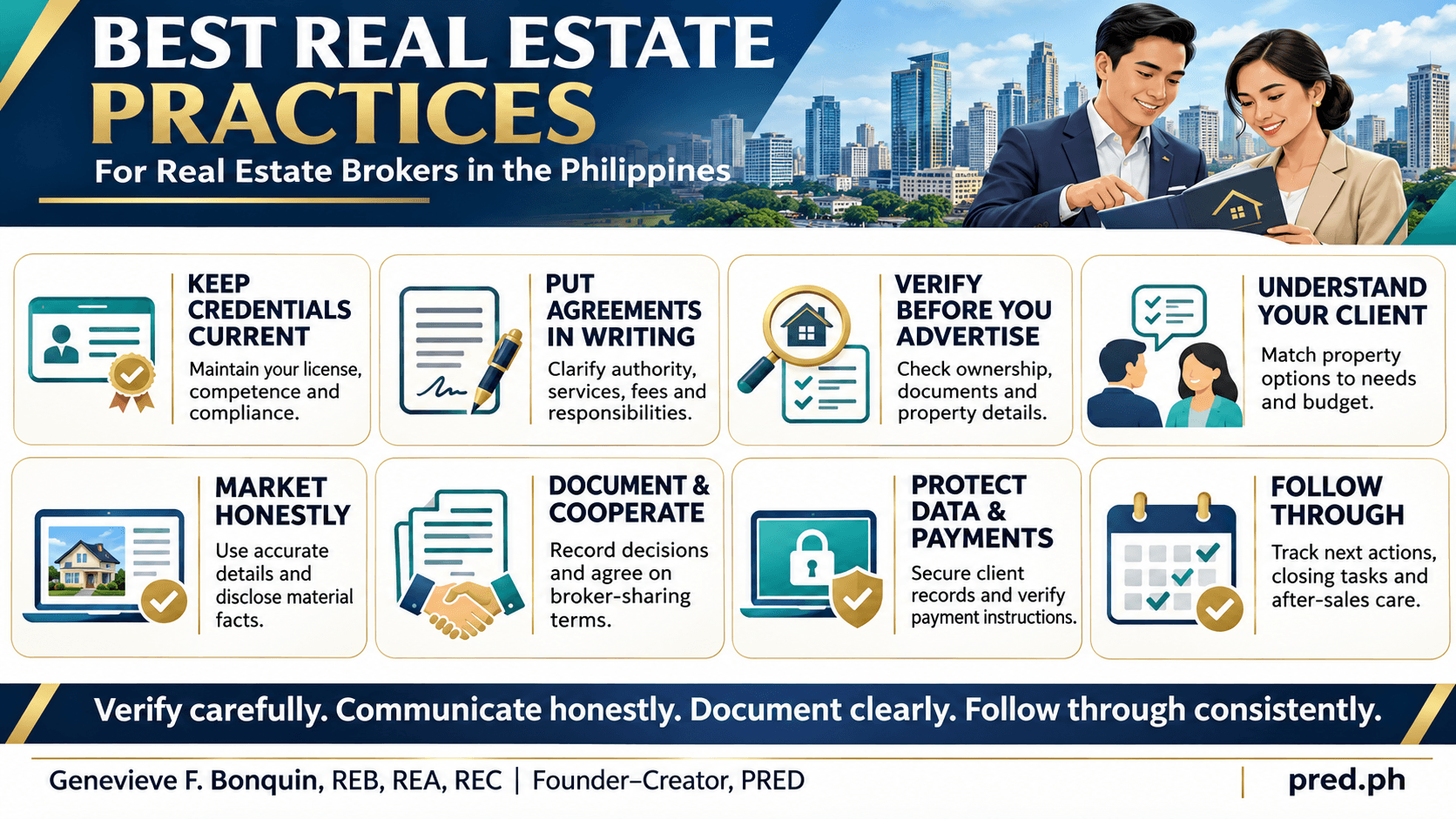
Best Real Estate Practices for Brokers in the Philippines
Building a practice grounded in competence, integrity, and client trust
By Genevieve F. Bonquin, REB, REA, REC
Founder–Creator, PRED
A real estate transaction can represent a family’s lifetime savings, an overseas worker’s years of sacrifice, or a business owner’s next major investment. The broker involved carries a responsibility that extends well beyond introducing a buyer to a seller.
Good brokerage requires preparation, verification, sound judgment, clear communication, and disciplined follow-through. These practices help protect clients, prevent disputes, and build a business that earns repeat clients and referrals.
For real estate brokers in the Philippines, the following practices provide a strong foundation.
1. Treat your license as an ongoing responsibility
Passing the licensure examination is the beginning of professional practice. Maintaining competence and complying with professional requirements must continue throughout a broker’s career.
Republic Act No. 9646, or the Real Estate Service Act of the Philippines, establishes the framework for regulated real estate service practice and distinguishes the roles of brokers, appraisers, consultants, and salespersons. A broker should understand these boundaries and work within the authority of their credentials.
Keep a compliance calendar for license renewal, applicable professional requirements, business permits, tax obligations, and other registrations relevant to your practice.
Make your professional identity easy for clients to verify. Use your proper name, accurate credentials, and consistent contact information across your documents and online profiles.
Good practice begins with being accountable for the professional identity you present.
2. Establish the engagement before marketing the property
A seller’s message saying “Please help me sell” leaves many questions unanswered.
Who has authority to appoint the broker? What services are expected? May the property be advertised publicly? Is the engagement exclusive? When does the commission become payable?
Before investing in marketing, obtain a written agreement appropriate to the engagement. It should clearly address:
The property and the parties involved.
The owner’s or representative’s authority.
The scope and duration of the engagement.
The seller-approved asking price and terms.
Marketing permissions and expenses.
Professional fees and the circumstances that trigger payment.
Arrangements for cooperation with other brokers.
Termination and treatment of previously introduced prospects.
Explain the agreement before asking anyone to sign. A document serves its purpose when the parties understand their responsibilities.
3. Verify before you advertise
A forwarded listing is a lead for investigation. It is not sufficient evidence that a property is ready to market.
Create a verification process that covers the seller, the property, and the authority to transact. Depending on the transaction, this may involve checking identity documents, obtaining a recent certified true copy of the title, reviewing annotations, examining tax records, and confirming representatives' authority.
Visit the property whenever practicable. Check its actual location, occupancy, access, condition, and whether it matches the information supplied.
For subdivision and condominium projects subject to licensing requirements, verify the relevant project registration and License to Sell with DHSUD. Check that the documents cover the specific project or phase being offered. DHSUD identifies project registration and the License to Sell as distinct approvals under Presidential Decree No. 957.
Keep a record of what you checked, when you checked it, and what remains unresolved. Refer legal, survey, engineering, or other specialist questions to qualified professionals.
Never describe an unresolved issue as settled simply to make a listing easier to sell.
4. Understand the client before recommending a property
A property can fit a buyer’s budget and still be unsuitable for the buyer’s life.
Ask about the purpose of the purchase, financing plans, household needs, preferred location, expected holding period, and tolerance for repairs or delays.
For sellers, understand their timetable, occupancy arrangements, document readiness, and reasons for selling. Identify who must participate in decisions and signatures.
A buyer needs assessment and a seller interview form can make these conversations more consistent. They also help prevent unnecessary viewings and mismatched expectations.
Recommend properties based on the client’s requirements. Explain the trade-offs openly.
5. Respect the distinction between asking price and appraised value
An asking price, an appraised value, a lender’s valuation, and the final negotiated price serve different purposes.
Record the seller’s chosen asking price and authorized terms. When you need an independent opinion of market value, recommend engaging a licensed real estate appraiser.
Market information shared during a brokerage discussion should be accurately sourced and clearly explained. Do not present informal comparisons as a formal appraisal.
A broker who also holds an appraiser’s license should make clear which professional service is being provided and document that engagement appropriately. RA 9646 separately defines brokerage and appraisal services.
Clear professional boundaries help clients understand what they are relying on.
6. Advertise accurately and disclose material information
An attractive advertisement should help a buyer understand a property.
Confirm the details before publishing: property type, location, lot and floor areas, price basis, availability, inclusions, and relevant restrictions.
Avoid unsupported claims such as “guaranteed appreciation,” “risk-free investment,” or “sure loan approval.” Explain the basis and limitations of projections.
If photographs are digitally enhanced or virtually staged, identify that treatment. Do not use editing to conceal defects or create features that do not exist.
The PRC Code of Ethics requires honesty in advertising and professional dealings and addresses disclosure of material property facts. These standards should guide listing descriptions, videos, social posts, and private presentations alike.
Review your listings regularly. Correct changed prices and remove properties that are no longer available.
7. Communicate clearly and keep a reliable record
Clients should know what is happening, what they need to do, and what comes next.
Agree on a communication schedule. After important discussions, send a written recap covering decisions, outstanding documents, deadlines, and assigned responsibilities.
Be precise about transaction status. An expression of interest differs from an offer. A financing application differs from loan approval. A screenshot of a transfer differs from confirmed receipt of cleared funds.
When a client asks a question you cannot yet answer, explain what must be verified and provide a realistic time for an update.
A reliable broker follows through on commitments, including the commitment to obtain accurate information.
8. Cooperate with other brokers through clear agreements
Cooperation can expand opportunities for clients and brokers. It also creates room for disputes when responsibilities and compensation remain vague.
Before sharing sensitive information or arranging a joint viewing, establish the parties’ authority, respective roles, communication process, confidentiality expectations, and commission-sharing terms.
Document introductions and material agreements. Obtain the permissions needed before reposting another broker’s photographs or listing content.
Respect legitimate engagements and avoid bypassing cooperating professionals. The PRC Code of Ethics specifically addresses cooperation and written arrangements for commission sharing.
A dependable reputation among fellow brokers is an asset built through repeated fair dealings.
9. Protect client information and payment instructions
Brokerage files can contain identity documents, signatures, financial records, family details, and information about valuable assets.
Collect information for a defined purpose, explain how you will use it, and limit access to people who need it. Avoid posting complete titles, identification documents, or confidential transaction records in public groups.
Use secure accounts, strong passwords, controlled file access, and appropriate retention practices. The National Privacy Commission emphasizes that organizations handling personal information must respect data subjects’ rights.
Treat payment instructions with equal care. Independently verify changes to account details through a previously established contact channel. Confirm the recipient’s identity and authority, and document the payment process.
10. Include anti-money laundering compliance in your operations
Anti-money laundering compliance deserves a place in a broker’s operating procedures.
AMLC guidelines require real estate brokers to register individually as covered persons, including those practicing under a brokerage firm. Brokers should understand the applicable customer due diligence, beneficial ownership, recordkeeping, and reporting requirements.
Build these requirements into client onboarding and transaction review. Obtain appropriate training and maintain current procedures.
Unusual payment arrangements, unexplained third-party payments, or resistance to identification checks should prompt careful review under the applicable rules.
11. Supervise the team and standardize the work
A broker’s name should stand for an identifiable standard of service across the team.
Verify the accreditation and supervision arrangements of salespersons working under you. Train team members on authorized representations, advertising, document handling, client communication, and escalation of concerns.
Prepare standard procedures for accepting listings, qualifying inquiries, arranging viewings, presenting offers, and monitoring transactions.
Review actual work. A procedure becomes useful when people follow it and supervisors correct problems early.
12. Use technology to support consistent service
A CRM, organized digital folders, a transaction tracker, and a maintained professional profile can help brokers keep commitments.
Every active client record should show the latest discussion, current status, next action, responsible person, and follow-up date.
Platforms such as PRED can support this organized approach to professional visibility and practice management. Their value grows when brokers keep information accurate and use the tools regularly.
AI can help draft descriptions and organize ideas. The broker remains responsible for checking facts, protecting confidential information, and approving the final output.
13. Manage the practice as a business
Track income and expenses, maintain proper records, and set aside funds for taxes, renewals, training, and operating costs.
Measure activities that reveal the health of the business: verified listings, qualified inquiries, completed consultations, viewings, offers, closed transactions, and referrals.
Review where transactions stall. Repeated problems may point to weak qualification, incomplete documentation, unsuitable listings, or inconsistent follow-up.
A busy calendar does not always indicate a productive practice. Use records to identify which work creates value for clients and supports sustainable income.
14. Follow through after the sale
A signed agreement is one milestone in a longer process.
Clarify responsibilities for payments, taxes, registration, possession, document delivery, and turnover. Monitor the items included in your engagement and keep the client informed about outstanding steps.
Use a closing and turnover checklist. Record the delivery of keys and documents and refer unresolved technical or legal concerns to the appropriate professional.
After completion, request feedback and permission before publishing a testimonial. A thoughtful follow-up can reveal improvements that strengthen future service.
Professionalism is built through daily decisions
The quality of a real estate practice becomes visible in ordinary moments: checking a document, correcting an advertisement, explaining a risk, returning a call, or declining an arrangement that compromises professional standards.
These actions require time and discipline. They also give clients a reason to trust the broker’s work.
For Filipino real estate brokers, a lasting practice grows from a clear commitment:
Verify carefully. Communicate honestly. Document clearly. Follow through consistently.
This article provides general professional guidance. Transaction-specific legal, tax, valuation, and technical questions require advice from the appropriate qualified professionals.
Philippine Real Estate Directory — in your pocket.
Meeting a broker today? Check them on the spot.
The free PRED app puts the directory in your pocket. Verify a broker in the middle of a tripping, save listings you like, and send inquiries to licensed professionals anywhere in the Philippines.


Available on the App Store for iPhone and iPad, and on Google Play for Android.
Licensed professionals
Browse listings and profiles from credential-reviewed practitioners.
Search on the go
Find properties, professionals, news, and wanted inquiries anytime.
Save favourites
Keep a shortlist and revisit listings anytime.