Financing Options in the Philippines: A Homebuyer’s Guide
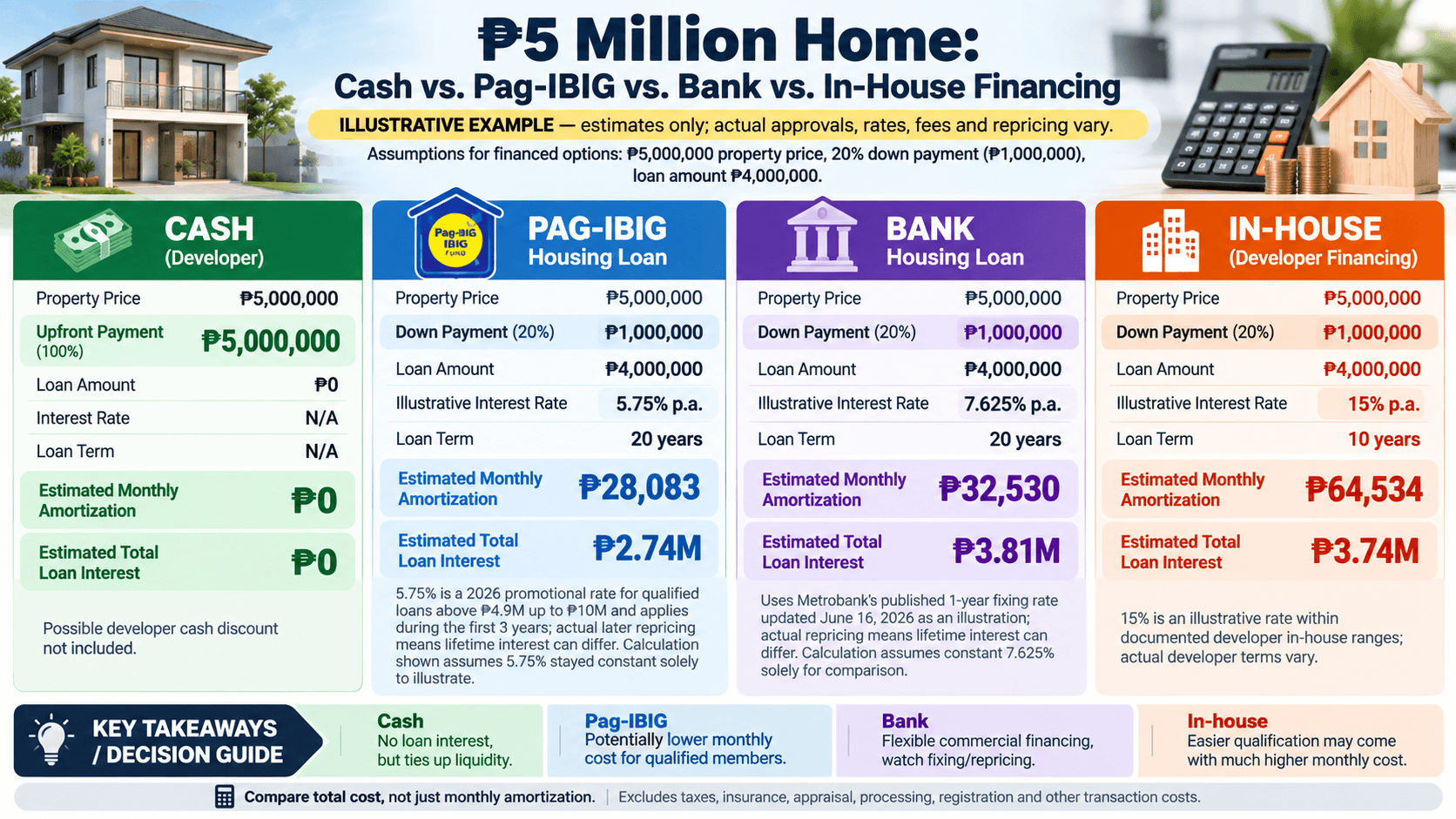
Financing Options in the Philippines: A Homebuyer’s Guide
Buying a home is one of the largest financial commitments most Filipinos will ever make. While finding the right property is important, deciding how to finance it can be just as important.
A property may look affordable based on its selling price, but financing can significantly change its actual cost. Interest rates, loan terms, down payments, insurance, bank charges, appraisal fees, and future interest-rate adjustments can add hundreds of thousands—or even millions of pesos—to the total amount ultimately paid.
For this reason, buyers should not ask only:
“Can I afford the down payment?”
They should also ask:
“Can I comfortably afford this property for the next 10, 20, or 30 years?”
In the Philippines, homebuyers generally have four major financing options:
Pag-IBIG Fund Housing Loan
Bank Housing Loan
Developer or In-House Financing
Cash or Deferred Cash Payment
No single financing option is automatically right for every buyer. The appropriate choice depends on the buyer's income, employment or business history, available cash, credit standing, property type, purchase price, and long-term financial plans.
1. Pag-IBIG Fund Housing Loan
For many Filipino homebuyers, a Pag-IBIG Housing Loan is one of the first financing options worth investigating.
Pag-IBIG financing may be used for qualifying residential purchases and other eligible housing purposes, subject to the Fund's requirements and appraisal.
Important 2026 developments
Pag-IBIG increased its maximum housing loan amount to ₱10 million per borrower in 2026, expanding the program beyond lower-priced housing and making it relevant to more middle-income homebuyers.
For qualified borrowers, the government announced the following 2026 rates:
Housing category
2026 rate
Qualified socialized housing under Expanded 4PH
3% p.a. subsidized rate
Qualified loans above the socialized ceiling up to ₱4.9 million
4.5% p.a. promotional rate
Qualified loans above ₱4.9 million up to ₱10 million
5.75% p.a. promotional rate
The 4.5% and 5.75% promotional rates apply to the first three years of qualifying loans and, according to current government announcements, are available for qualified applications through December 31, 2026.
This distinction is extremely important.
A buyer should not assume that receiving a 4.5% Pag-IBIG promotional rate means paying 4.5% for the entire 20- or 30-year loan.
Always ask:
“What happens to my interest rate after the promotional or fixed-rate period expires?”
Who should consider Pag-IBIG?
Pag-IBIG financing can be particularly attractive to qualified employed Filipinos, OFWs, self-employed members, and other eligible Pag-IBIG members who want long repayment periods and competitive housing financing.
Membership and contribution requirements apply. Pag-IBIG housing programs generally require the equivalent of at least 24 months of savings, although applicable rules may allow the required savings to be completed under Pag-IBIG guidelines. Qualification also depends on income, capacity to pay, and credit/background requirements.
Advantages
One major attraction is relatively affordable financing combined with long repayment periods.
A longer loan term lowers the monthly amortization, which can make homeownership more accessible.
But remember:
Lower monthly amortization does not necessarily mean a cheaper house.
Extending a loan from 15 years to 30 years can substantially increase the total interest paid over the life of the loan.
Possible disadvantages
Pag-IBIG financing requires documentation, property evaluation, borrower qualification, and processing. Buyers should therefore allow enough time between loan application and the seller's required payment or turnover date.
A buyer should never assume that the entire selling price will automatically be financed.
The approved loan depends on factors that can include the property's appraised value, the borrower's income and capacity to pay, and Pag-IBIG's applicable lending rules.
2. Bank Housing Loans
Commercial banks are another major source of Philippine real estate financing.
Banks can be especially useful for buyers purchasing higher-value properties, borrowers who do not intend to use Pag-IBIG, and transactions involving developers already accredited by a particular bank.
What are bank housing loan rates in 2026?
There is no single Philippine “bank housing loan rate.”
Rates vary according to:
bank
borrower profile
loan amount
property
promotional program
loan term
interest-rate fixing period
existing relationship with the bank
For example, Metrobank's published June 2026 rates ranged from 7.625% for a one-year fixing period to 8.75% for five years, although rates and promotions can change. Earlier 2026 promotional programs from major banks also offered lower introductory rates to qualifying borrowers.
Therefore, buyers should treat figures such as 6%–9% as a general market reference rather than a guaranteed rate.
Understanding the “fixing period”
This is one of the most misunderstood parts of housing loans.
Suppose a bank offers:
6.5% fixed for five years
on a 20-year housing loan.
That does not necessarily mean 6.5% for 20 years.
It generally means that the interest rate is fixed for the specified initial period. After that period, the loan may be repriced according to the lender's applicable terms.
Metrobank, for example, expressly states that its home loans are repriced after the fixing period.
A borrower should therefore ask the bank:
“How will my loan be repriced after the fixed period?”
This can be more important than choosing between two loans based solely on their introductory rates.
3. How Much Will a Bank Finance?
Banks generally do not simply lend the full selling price.
Financing may be based on a percentage of the property's appraised value or other applicable valuation.
For example, Metrobank states that certain residential home loans can finance up to 80% of property value or total cost, subject to qualification.
This creates an important issue for buyers.
Imagine:
Selling price: ₱8,000,000
Bank appraisal: ₱7,000,000
Maximum financing: 80% of appraisal
Potential loan:
₱7,000,000 × 80% = ₱5,600,000
The buyer would therefore have to provide:
₱8,000,000 − ₱5,600,000 = ₱2,400,000
plus applicable taxes, fees and transaction expenses.
This is why buyers should never calculate their required cash solely from the developer's advertised down payment.
4. Bank Approval Is Also About the Borrower
The property is only one part of the bank's decision.
Banks also evaluate the borrower.
Typical considerations include:
Income and capacity to pay. Can the borrower's documented income support the monthly amortization?
Employment stability. How long has the borrower been employed?
Business history. Self-employed borrowers may need financial statements, tax returns and evidence that the business has operated profitably for a certain period.
Credit history. Existing credit cards, car loans, personal loans and previous payment behavior can affect approval.
Existing obligations. A person earning ₱150,000 monthly but already paying several loans may have less borrowing capacity than someone earning ₱100,000 with little debt.
For example, Metrobank currently publishes eligibility requirements including minimum income and employment/business-history requirements, while also requiring satisfactory credit standing.
5. Developer or In-House Financing
Some developers offer financing directly to buyers.
This can be useful when a buyer cannot yet qualify for bank or Pag-IBIG financing.
The biggest attraction is usually easier qualification.
Documentation requirements may be simpler, and developers may be more flexible regarding income documentation.
However, convenience normally comes at a price.
Developer financing can carry considerably higher effective financing costs than conventional housing loans. For example, Filinvest Land reported in its 2025 annual report that interest rates on its in-house financing typically ranged from 11.5% to 19% annually, depending on loan term. This illustrates why buyers must obtain the actual financing terms from the specific developer rather than assume a standard market rate.
When can in-house financing make sense?
It can function as a bridge.
For example:
A buyer reserves a condominium during pre-selling.
The buyer pays:
Reservation fee → monthly down payment → developer installments
while the project is being constructed.
Before turnover, the buyer applies for bank or Pag-IBIG financing for the remaining balance.
This can allow the buyer time to:
improve credit standing;
establish a longer employment record;
build a business track record;
increase documented income;
accumulate savings; and
prepare loan requirements.
But there is an important risk.
Refinancing is never guaranteed.
A buyer should not purchase a property today on the assumption:
“I'll just get a bank loan three years from now.”
The buyer's financial condition, bank lending rules, interest rates, property appraisal and credit standing may all be different by then.
6. Cash and Deferred Cash
For buyers with sufficient liquidity, cash remains the simplest financing method.
A developer may offer either:
Spot cash — most or all of the price is paid within a short period.
or
Deferred cash — the purchase price is divided over a specified period, sometimes without conventional loan interest.
Developers may offer discounts or incentives for these payment arrangements, but the exact discount varies widely by project and promotion.
Why developers offer discounts
Cash reduces financing and collection risk for the developer.
The developer receives money earlier instead of waiting years for installment payments.
The buyer may therefore receive:
cash discounts;
waived charges;
special pricing;
free upgrades; or
other promotional incentives.
But buyers should compare the discount against the value of keeping their money invested or available for emergencies.
Paying ₱8 million cash for a house just to get a discount may not be financially sensible if it leaves the buyer with almost no emergency reserves.
7. The Hidden Cost of Housing Loans
The interest rate is not the only financing cost.
Depending on the lender and transaction, buyers may encounter:
appraisal fees
processing or handling fees
title investigation fees
mortgage registration expenses
documentary stamp taxes
notarial expenses
Mortgage Redemption Insurance (MRI)
fire/property insurance
bank charges
transfer and registration expenses
For example, Metrobank lists appraisal, title investigation, handling, mortgage insurance and property insurance among possible home-loan-related costs.
Therefore, buyers should ask lenders for a written breakdown of all charges, not merely the monthly amortization.
8. Don't Confuse Interest Rate With Total Cost
Consider two lenders.
Lender A
Interest: 6.5%
Higher processing and insurance charges
Lender B
Interest: 6.75%
Lower fees and more favorable prepayment terms
The loan with the lowest advertised interest rate may not necessarily produce the lowest overall cost.
Compare:
Total cash required + monthly payments + fees + insurance + potential repricing + prepayment costs.
That gives a much more realistic picture.
9. Why Loan Term Matters
Suppose a buyer borrows ₱4 million.
A 10-year loan produces a much higher monthly payment than a 20- or 30-year loan.
But the shorter loan normally means substantially less total interest.
This creates a trade-off:
Shorter term:
Higher monthly amortization, lower total interest.
Longer term:
Lower monthly amortization, higher total interest.
The appropriate question is therefore not:
“What is the longest loan I can get?”
It is:
“What is the shortest loan term I can comfortably sustain without putting my household finances at risk?”
10. Prepayment Can Make a Huge Difference
A 20- or 30-year housing loan does not always mean the borrower must take that long to repay it.
Some borrowers intentionally select a longer term to keep the required monthly amortization manageable but make additional principal payments whenever they receive:
bonuses;
commissions;
business profits;
13th-month pay;
investment proceeds; or
other excess cash.
Paying down principal early can substantially reduce future interest.
However, check the lender's rules first.
Some banks impose prepayment, early settlement, or processing charges under particular circumstances. Metrobank, for example, publishes a prepayment processing fee among its current home-loan service charges.
11. A Common Condo Financing Strategy
A common structure for Philippine condominium purchases is:
Reservation → Equity/Down Payment During Construction → Bank or Pag-IBIG Takeout → Long-Term Amortization
For example, assume a condominium costs ₱6 million.
The developer might structure payment as:
Reservation fee
↓
20% equity during construction
↓
80% balance upon turnover
The buyer pays the equity while the condominium is being built.
Before turnover, the buyer applies for financing for the remaining balance.
This arrangement gives the buyer several years to prepare.
However, buyers should begin preparing for financing well before turnover.
Waiting until the developer issues the final turnover notice can create serious problems if the bank rejects the application or approves less than expected.
12. The Financing Gap Buyers Often Overlook
One of the most dangerous situations is a loan shortfall.
Suppose:
Property price: ₱10 million
Remaining balance at turnover: ₱8 million
Buyer expects bank financing: ₱8 million
But the bank approves only:
₱6.5 million
The buyer suddenly needs:
₱1.5 million in additional cash.
If the buyer cannot produce it, penalties, cancellation issues or loss of previous payments may arise depending on the contract and applicable law.
That is why you should plan financing before buying, not after.
13. How Much House Can You Really Afford?
A bank or Pag-IBIG approval tells you how much the lender is willing to lend.
It does not necessarily tell you how much you should borrow.
Your monthly housing budget should also leave room for:
food
utilities
transportation
children's education
medical expenses
insurance
emergency savings
retirement savings
condominium dues or homeowners' association dues
real property taxes
home repairs and maintenance
A borrower who uses almost every peso of disposable income for mortgage payments becomes vulnerable to even a small financial emergency.
14. Build a Financial Buffer
Before purchasing a property, buyers should ideally maintain funds beyond the down payment.
Homeownership brings expenses that renters may not encounter.
A newly turned-over condominium, for example, may require:
move-in fees;
association dues;
utility deposits;
furniture;
appliances;
renovations;
parking expenses; and
insurance.
A house may require immediate repairs, security improvements, landscaping or utility connections.
The true cost of moving into a property therefore goes beyond the selling price.
15. Financing Comparison
Option
Generally suitable for
Main advantage
Main consideration
Pag-IBIG Housing Loan
Qualified Pag-IBIG members
Competitive rates and long terms
Eligibility, documentation, appraisal and loan limits
Bank Housing Loan
Buyers with documented income and good credit
Wide range of financing and relatively fast commercial processing
Rate repricing and bank fees
Developer/In-House Financing
Buyers unable to obtain conventional financing immediately
Easier qualification
Usually much more expensive
Cash/Deferred Cash
Buyers with substantial liquidity
No long-term mortgage; possible developer incentives
Large amount of capital tied up
16. Questions Every Buyer Should Ask Before Signing
Do not ask only:
“What is the monthly amortization?”
Ask the lender or developer:
What is the actual interest rate?
How long is that rate fixed?
What happens after the fixed-rate period?
How is the new rate calculated?
What percentage of the property's value can be financed?
Is financing based on selling price or appraised value?
What income is required?
What are all the loan fees?
Is MRI required?
Is property insurance required?
Are advance principal payments allowed?
Is there a prepayment penalty or processing fee?
Can the loan be refinanced?
What happens if the bank appraisal is below the selling price?
How much cash must I have available before loan takeout?
These questions can reveal the true cost of the transaction.
17. A Better Way to Compare Financing
Before choosing a financing package, prepare a simple comparison sheet.
For every option, write down:
Property price
Down payment/equity
Loan amount
Interest rate
Rate-fixing period
Loan term
Estimated monthly amortization
Loan fees
Insurance
Estimated total payments
Prepayment rules
Repricing rules
Then compare them side by side.
The cheapest-looking monthly payment may not be the cheapest financing arrangement.
18. The Most Important Rule: Get Financing Ready Before You Commit
Many buyers follow this sequence:
Find property → Pay reservation → Worry about financing later.
A safer sequence is:
Assess finances → Determine financing capacity → Obtain preliminary loan assessment → Set property budget → Search for property → Verify property and seller → Review contract → Commit.
This prevents one of the most common homebuying mistakes: falling in love with a property first and discovering later that it cannot be comfortably financed.
Final Takeaway
Choosing a property and choosing a housing loan should be treated as two separate decisions.
A beautiful property can become a financial burden if the financing structure is wrong.
Pag-IBIG may provide attractive financing for qualified members. Banks can provide flexibility and financing for a wide range of properties. Developer financing can help bridge qualification gaps but can be considerably more expensive. Cash can eliminate borrowing costs but can also reduce liquidity.
The objective should not simply be to obtain the largest loan available.
The objective is to choose a property and financing structure that you can comfortably sustain while still maintaining savings, emergency funds and financial flexibility.
Before signing a reservation agreement, contract to sell or housing loan agreement, understand three numbers:
How much cash do I need now?
How much must I pay every month?
How much could I ultimately pay over the entire financing period?
A home should help build financial security—not place the buyer under financial stress.
Rates, promotions, loan ceilings and eligibility requirements can change. The figures discussed here reflect publicly available information as of September 2026. Buyers should obtain the latest written quotation and terms directly from Pag-IBIG Fund, their bank or the property developer before making a financial commitment.
Philippine Real Estate Directory — in your pocket.
Meeting a broker today? Check them on the spot.
The free PRED app puts the directory in your pocket. Verify a broker in the middle of a tripping, save listings you like, and send inquiries to licensed professionals anywhere in the Philippines.


Available on the App Store for iPhone and iPad, and on Google Play for Android.
Licensed professionals
Browse listings and profiles from credential-reviewed practitioners.
Search on the go
Find properties, professionals, news, and wanted inquiries anytime.
Save favourites
Keep a shortlist and revisit listings anytime.