First-Time Home Buyer’s Guide Philippines: 10 Things to Know Before You Buy
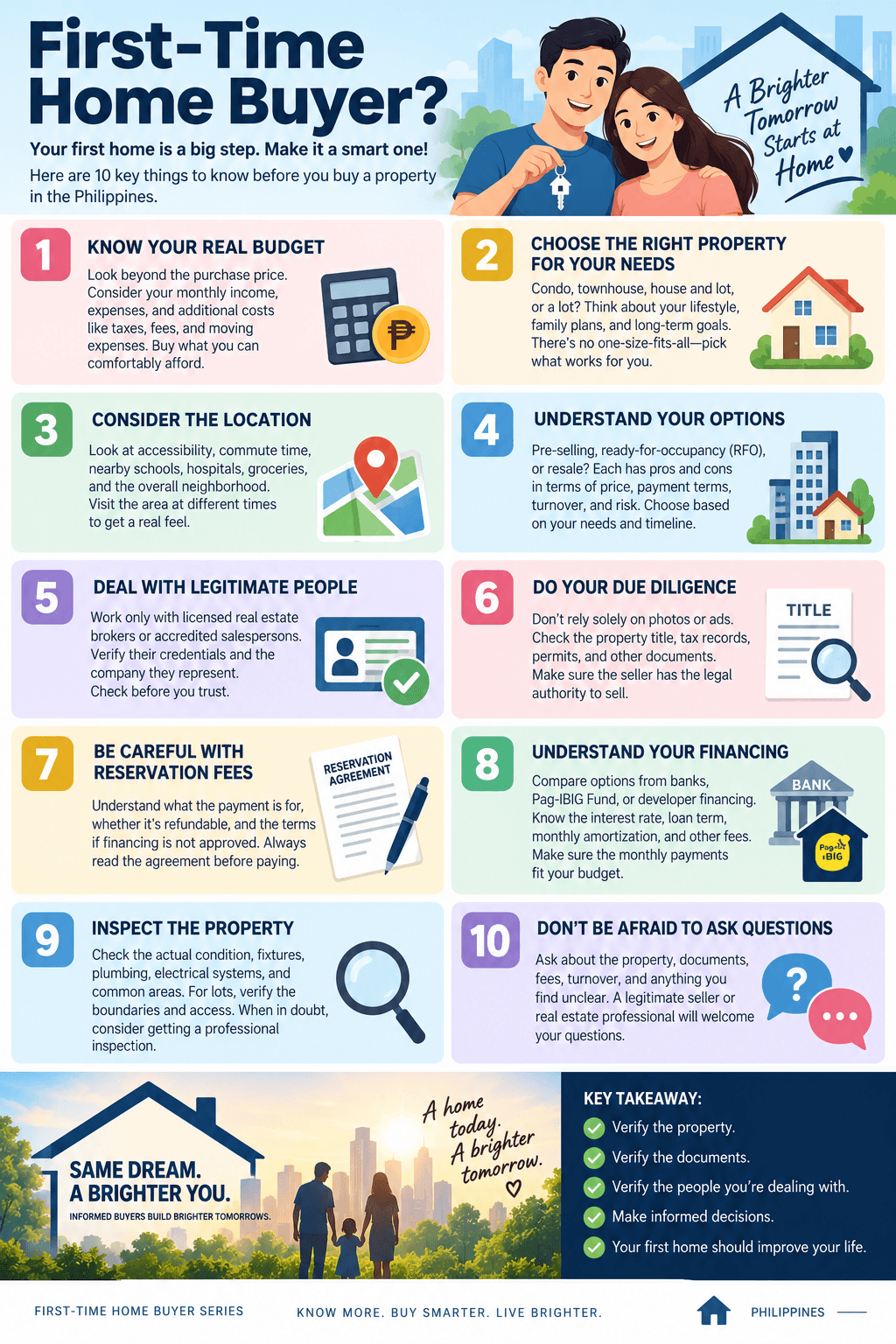
First-Time Home Buyer’s Guide Philippines: 10 Things to Know Before You Buy
Buying your first home is exciting—but it can also be overwhelming.
Should you buy a condominium, townhouse, or house and lot? How much can you really afford? Should you choose a pre-selling property or one that is ready for occupancy? How do you know whether the person offering the property is legitimate? What documents should you check before paying a reservation fee?
For many Filipinos, buying a home will be one of the biggest financial decisions they will ever make. A beautiful property matters, but a safe, financially manageable transaction matters more.
Before you start viewing properties, here are 10 things every first-time home buyer in the Philippines should know.
1. Know Your Real Budget
Your budget is not simply the amount a bank or developer says you can borrow.
Start with your monthly income and regular expenses. Ask yourself how much you can comfortably allocate to housing every month while still leaving room for food, utilities, transportation, insurance, emergencies, education, savings, and other obligations.
Remember that buying a home involves more than the purchase price.
Depending on the transaction, you may also encounter expenses involving documentation, taxes and fees, loan charges, insurance, association dues, repairs, renovations, moving costs, furnishings, and other incidental expenses.
A home should improve your quality of life—not leave you struggling every month just to make the payments.
2. Decide What Kind of Property Fits Your Needs
Don't begin with the question:
“What property can I buy?”
A better question is:
“What kind of home do I actually need?”
Consider your present situation and your plans for the next several years.
Do you need to be close to your workplace? Do you have children or plan to have them? Do you need access to schools, hospitals, transportation, markets, or business districts? Would you prefer condominium living or the additional space of a house and lot?
You may encounter several options:
Condominium
Townhouse
House and lot
Residential lot on which you can build later
Pre-selling development
Ready-for-occupancy property
Resale property
There is no single property type that is right for everyone. The best fit depends on your budget, lifestyle, location requirements, and long-term plans.
3. Location Is More Than Just the Address
A property may look affordable until you calculate the cost of living there.
Consider your daily commute, transportation options, traffic, accessibility, nearby schools, hospitals, groceries, workplaces, and other essential services.
Visit the area at different times if possible.
A neighborhood can feel completely different during weekday rush hour, late at night, or after heavy rain.
For houses and lots, buyers should also investigate matters such as access roads, drainage and flooding concerns, neighborhood conditions, and nearby developments that could affect the property in the future.
4. Understand Pre-Selling, RFO, and Resale Properties
First-time buyers frequently encounter these three choices.
Pre-selling properties are purchased before completion or while the project is being developed. Payment arrangements can sometimes make the initial cash requirement more manageable, but buyers must understand the construction schedule, turnover conditions, financing requirements, and developer documentation.
Ready-for-occupancy (RFO) properties allow buyers to see an existing or substantially completed unit before committing.
Resale properties are properties being sold by their current owners. These can provide attractive opportunities, but buyers need to conduct careful due diligence regarding ownership, title, taxes, liens or encumbrances, possession, and the physical condition of the property.
Never choose based on price alone.
5. Know Who You Are Dealing With
This is one of the most important rules for first-time home buyers.
Before giving money or sensitive personal information to someone representing a property, establish who that person is and what authority he or she has to participate in the transaction.
In Philippine real estate transactions, you may encounter licensed real estate brokers as well as accredited real estate salespersons working under supervising brokers.
Ask for identification and professional credentials where appropriate.
If someone claims to be a licensed real estate broker, verify that claim rather than relying solely on a Facebook profile, advertisement, business card, or verbal representation.
Verify before you trust.
6. Never Let Beautiful Photos Replace Due Diligence
Professional photographs, drone shots, virtual tours, and social-media posts are useful marketing tools—but they are not proof of ownership.
Before making a major payment, determine who owns the property and whether the person selling it has authority to do so.
For titled properties, appropriate due diligence may include examining the title and checking for annotations, mortgages, liens, adverse claims, or other matters affecting the property.
Depending on the property and transaction, additional documents may also need to be reviewed, including tax declarations, real property tax records, subdivision or condominium documents, permits, contracts, and the seller's authority to sell.
When necessary, obtain assistance from qualified real estate and legal professionals.
7. Be Careful With Reservation Fees
First-time buyers can feel pressured when told:
“Someone else is interested. Reserve it today.”
Urgency should never replace verification.
Before paying, understand exactly what the payment is for.
Ask questions such as:
Is the reservation fee refundable?
Under what circumstances?
Will it form part of the purchase price?
What happens if financing is not approved?
What happens if the buyer decides not to proceed?
Who is legally receiving the money?
What document will you receive acknowledging the payment?
Read the reservation agreement or related document before signing and paying.
If important conditions are only being promised verbally, ask for them to be put in writing.
8. Understand Your Financing Before Committing
Many buyers concentrate on the down payment and postpone thinking about the housing loan.
That can be a costly mistake.
Before committing to a property, understand how you intend to finance the balance.
Depending on your circumstances, financing may come from a bank, Pag-IBIG Fund, developer financing, or personal funds.
Consider the loan amount, interest rate, repayment period, monthly amortization, insurance requirements, fees, and what happens if interest rates or other financing conditions change.
Ask yourself a simple question:
“Can I comfortably continue paying for this home even if my household expenses increase?”
Buying at the maximum amount you can possibly borrow is not always the same as buying what you can comfortably afford.
9. Inspect the Property Carefully
For an existing house, condominium, or townhouse, inspect the property before finalizing the purchase.
Look beyond freshly painted walls.
Check plumbing, electrical systems, water pressure, leaks, signs of moisture, structural concerns, windows, doors, fixtures, parking, common areas, and the general condition of the building or neighborhood.
For condominium properties, ask about association dues, building rules, parking arrangements, amenities, and other recurring charges.
For vacant lots, verify the actual location and boundaries. A professional survey may be appropriate depending on the circumstances.
A relatively small inspection expense can sometimes prevent a much larger problem later.
10. Don't Be Afraid to Ask Questions
First-time buyers sometimes hesitate to ask questions because they worry that they will appear inexperienced.
Ask anyway.
A legitimate seller or real estate professional should expect reasonable questions about the property and transaction.
Ask about ownership.
Ask about the title.
Ask about financing.
Ask about fees.
Ask about commissions if relevant.
Ask about turnover.
Ask about taxes.
Ask about documents.
Ask who is responsible for each step.
And if something does not make sense, do not sign simply because someone tells you that a document is “standard.”
Understand what you are agreeing to.
Your First Home Should Begin With Verification
Buying your first home should be exciting, but excitement should be accompanied by careful due diligence.
Remember these three principles:
Verify the property.
Verify the documents.
Verify the people you are dealing with.
A few additional days spent checking a transaction can be insignificant compared with the years you may spend paying for the property.
Your first home may be one of the largest investments of your life.
Treat the decision accordingly.
PRED — Real Estate Philippines
Be Found. Be Verified. Be Trusted.
PRED helps the public discover and identify Philippine real estate service professionals and gives legitimate practitioners a professional online presence.
This article is intended for general educational information and is not a substitute for legal, financial, tax, surveying, or other professional advice appropriate to a particular transaction.
Philippine Real Estate Directory — in your pocket.
Download the app now
Browse property listings, verify licensed professionals, save favourites, and send inquiries — all in one trusted platform.


Available on the App Store for iPhone and iPad, and on Google Play for Android.
Licensed professionals
Browse listings and profiles from credential-reviewed practitioners.
Search on the go
Find properties, professionals, news, and wanted inquiries anytime.
Save favourites
Keep a shortlist and revisit listings anytime.