First-Time Homebuyer's Guide
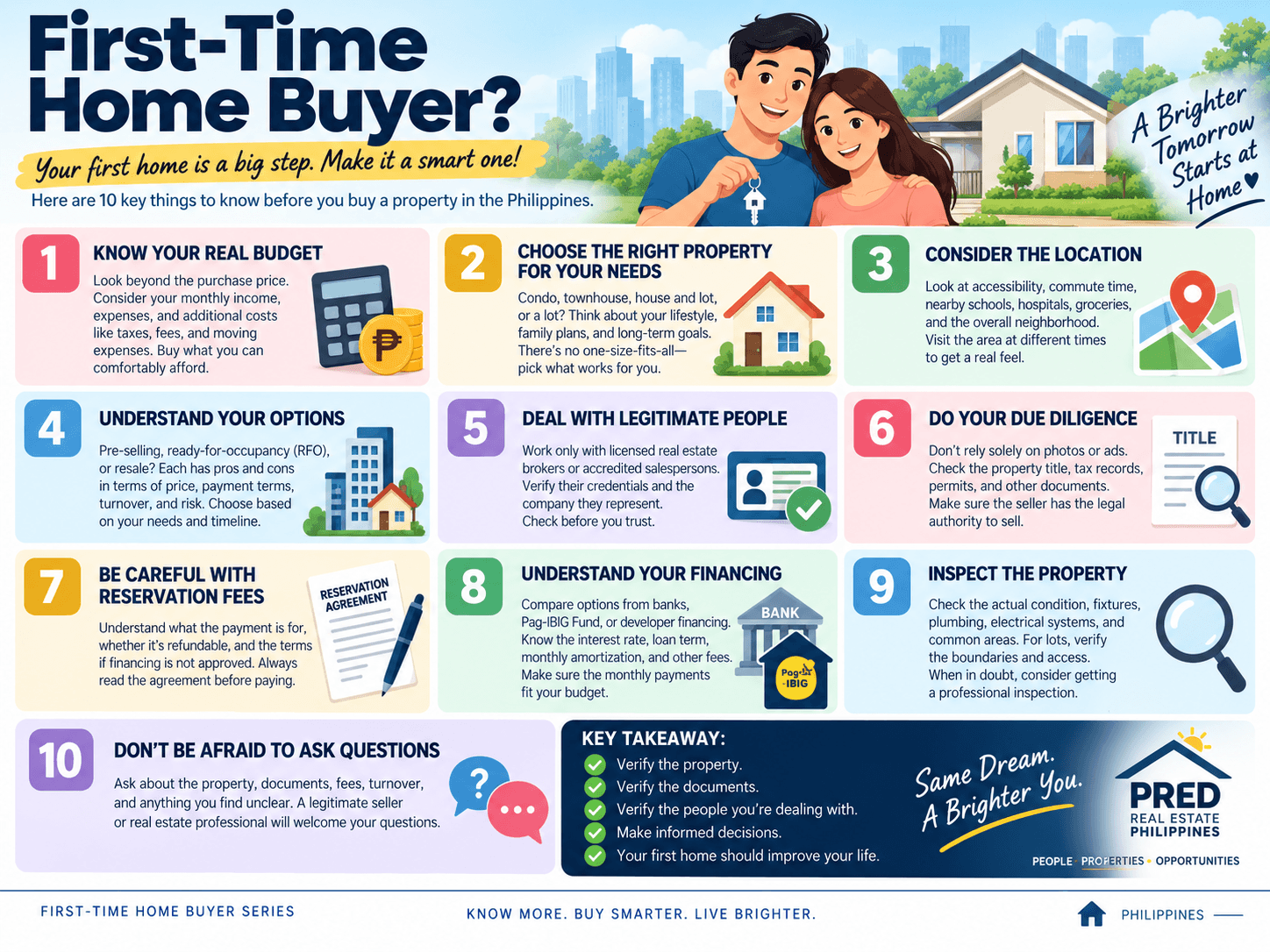
Part 1: Are You Financially Ready?
Before browsing listings, run yourself through this readiness check. Real estate is illiquid — getting in before you're ready is far more costly than waiting a year to prepare properly.
1. The Emergency Fund Test
You should have 3–6 months of living expenses saved in an emergency fund separate from whatever you're setting aside for a home. If a job loss or medical emergency would force you to raid your down payment savings, you're not ready yet.
2. The Debt-to-Income (DTI) Test
Banks and Pag-IBIG generally want your total monthly debt payments (including the new home loan) to stay at or below 30–35% of your gross monthly income. To estimate where you stand:
DTI = (Existing loan payments + estimated new mortgage payment) ÷ Gross monthly income
Add up existing obligations: credit cards, car loans, personal loans, other amortizations.
If you're already near or above 35% before adding a mortgage, pay down debt first — lenders will likely reject or scale down your loan application.
3. The Down Payment + Reserve Test
Can you comfortably do all of the following without wiping out your savings?
Pay 10–20% down payment (developers often ask 10–20% for pre-selling condos/house-and-lot; banks typically finance up to 80% of appraised value).
Cover closing costs of roughly 3–7% of the property price (documentary stamp tax, transfer tax, registration fees, notarial fees — more below).
Still have an emergency fund left over afterward.
If yes to all three, you likely pass the basic affordability test.
4. The Job/Income Stability Test
Lenders (and you) want to see:
At least 2 years of stable employment or business income (for Pag-IBIG, at least 24 months of active contributions is a common threshold).
Documentable income: payslips, ITR, Certificate of Employment, or audited financials/bank statements if self-employed or an OFW.
If your income is irregular or you're new in a job/business, it may be worth waiting 12–24 months to build a track record lenders can underwrite against.
5. The "Why" Test — Home vs. Investment
Be honest about your purpose, because it changes the math:
Buying to live in → prioritize location relative to work/family, total monthly housing cost vs. rent, and long-term livability.
Buying to invest/rent out → prioritize rental yield (annual rent ÷ property price, typically 4–7% gross in PH for condos), appreciation potential, and vacancy risk. Don't buy an investment property using the same emotional criteria you'd use for a family home.
6. Rent vs. Buy Comparison
Run the numbers before assuming buying is automatically better:
Total monthly cost of owning = mortgage amortization + association dues + property tax (amilyar) + insurance + maintenance reserve.
Compare this to current rent for an equivalent unit.
Buying usually only "wins" financially if you plan to stay 5+ years — the upfront transaction costs (both buying and eventual selling) take years to offset through equity buildup and appreciation.
Part 2: Choosing the Right Property
Once you know your budget, narrow the market using these filters — in roughly this order.
1. Set a Hard Price Ceiling First
Work backward from your approved/pre-qualified loan amount plus available down payment, not from what looks nice online. A useful anchor: total monthly housing cost (amortization + dues + property tax + insurance) should not exceed what you tested in your DTI check (Part 1). Don't let a broker or developer talk you into "stretching a bit" — that stretch compounds every month for 15–30 years.
2. Match Property Type to Your Purpose and Budget
Type
Pros
Watch out for
Condominium
Lower entry price in urban areas, amenities, security, easier to rent out
Monthly association dues (can rise over time), smaller space, building age/maintenance quality
House and Lot (subdivision)
Land ownership, more space, room to expand, generally appreciates well
Usually farther from city centers, commute cost/time, subdivision dues
Townhouse
Middle ground on price and space
Shared walls, sometimes limited land title (check if lot is individually titled)
Lot only
Cheapest entry, build later on your terms
No immediate shelter, financing for lot-only is often harder to get than for house-and-lot
Resale/pre-owned
Move in faster, see exactly what you're buying, often negotiable price
Requires more hands-on due diligence, may need renovation budget
Pre-selling
Lower price, flexible in-house payment terms during construction
Delivery delay risk, can't inspect the actual finished unit yet, check developer track record
3. Location: Weigh These Factors
Commute to work/school — calculate actual door-to-door time, not straight-line distance; this is often the single biggest quality-of-life factor.
Flood and hazard risk — check local flood maps (many LGUs and DHSUD publish hazard maps) before falling for a low price in a low-lying area.
Access to essentials — hospital, market/grocery, public transport, school, church, as relevant to your household.
Neighborhood trajectory — is the area improving (new infrastructure, malls, transit lines) or stagnant? This affects both livability and resale value.
Noise, security, and utilities reliability — visit at different times of day (weekday rush hour, night, weekend) before deciding, not just during a single showing.
4. Size the Property to Your Actual Life, Not Just Today
Think 5–10 years out: growing family, aging parents moving in, remote-work space needs.
For condos, check the actual usable floor area (not just the advertised "gross" area, which can include walls and common areas).
Don't over-buy space you'll rarely use — extra square meters mean a bigger loan, higher dues, and more to maintain/cool.
5. If Buying Partly as an Investment
Check rental comparables in the immediate area (not the whole city) to estimate realistic rent, not the developer's optimistic projection.
Target areas with real, non-speculative rental demand — near universities, BPO/office hubs, hospitals, or transit stations tend to hold up better than purely speculative "up-and-coming" zones.
Watch for oversupply. Some segments (especially Metro Manila condos) have had a significant glut of unsold ready-for-occupancy units in recent years — oversupplied areas can mean flat or falling prices and harder resale, even if rental demand exists.
Run the numbers on gross rental yield (annual rent ÷ property price): anything comfortably above your loan's interest rate is a healthier sign than a property that barely breaks even.
6. Inspect Before You Commit
For resale/RFO: visit in person, check for water damage, cracks, plumbing/electrical issues, and ask for the latest amilyar (real property tax) and association dues receipts.
For pre-selling: ask for the DHSUD-registered project details and License to Sell, and review the developer's delivery track record on past projects.
Bring a contractor or engineer along for a serious resale purchase if the price is significant — a few thousand pesos for an inspection can save you from a costly structural surprise.
7. Sanity-Check Against Your Budget One More Time
Before making an offer or paying a reservation fee, re-run your DTI and total monthly cost math (Part 1) using the specific unit's actual price, dues, and taxes — not the generic estimate you started with. Developers and brokers often quote a “starting price” that excludes VAT, parking, or premium floor/view charges; get the all-in price in writing before you commit.
Part 3: Financing Options in the Philippines
Option
Best for
Typical Rate (2026)
Notes
Pag-IBIG Fund Housing Loan
Employed/OFW members with 24+ months of contributions
Promo rates ~4.5%–5.75% (up to ₱10M loan ceiling); 3% for qualified socialized housing under the 4PH program
Loan ceiling was raised to ₱10 million in 2026; terms up to 30 years. Best rates in the market, but slower processing and stricter documentation.
Bank Housing Loan
Buyers wanting speed or amounts above Pag-IBIG limits
Roughly 6%–9%, depending on bank, loan size, and fixing period
Typically finances up to 70–80% of appraised value; faster approval than Pag-IBIG but higher rates.
In-house/Developer Financing
Buyers who don't yet qualify for bank/Pag-IBIG loans
Higher effective rates, often 12–18%+
Easier approval, minimal documentation, but expensive — best used short-term (e.g., during pre-selling) before refinancing into a bank or Pag-IBIG loan.
Cash/Deferred Cash (Developer)
Buyers with liquidity, often for pre-selling discounts
N/A (0% if paid within construction period)
Developers often discount 5–15% for cash buyers.
Tip: Many buyers use in-house financing to cover the pre-selling/construction period, then refinance into a Pag-IBIG or bank loan once the unit is ready for occupancy (turnover) — this is a standard strategy for condo buyers.
Part 4: The Full Cost of Buying (Beyond the Price Tag)
Budget for these on top of the purchase price and down payment:
Documentary Stamp Tax (DST): ~1.5% of the selling price or zonal value, whichever is higher — by custom, usually shouldered by the buyer.
Local Transfer Tax: ~0.5%–0.75% of the property value, paid to the city/municipal treasurer — buyer's cost.
Registration Fees (Registry of Deeds): Based on a graduated schedule tied to property value.
Notarial Fees: ~1–2% of the contract price, or a flat fee depending on the notary.
Capital Gains Tax (6%): By custom this is the seller's obligation (not yours as buyer) — but confirm in the contract, since it's sometimes negotiated.
VAT (12%): Applies if buying from a VAT-registered developer above the VAT threshold (relevant mainly for pre-selling purchases from large developers) — usually already embedded in the listed price.
Reservation Fee: ₱10,000–₱50,000+ typically required upfront when reserving a pre-selling unit; usually non-refundable if you back out.
Rule of thumb: set aside 3–7% of the property price for buyer-side closing costs, on top of your down payment.
Part 5: Step-by-Step Buying Process
Get your finances in order. Build your emergency fund, pay down high DTI debt, and start (or continue) Pag-IBIG contributions if you plan to use it.
Get pre-qualified/pre-approved. Ask your bank or Pag-IBIG how much you can borrow before falling in love with a property. This anchors your search to a realistic budget.
Set your budget and must-haves. Location (commute, schools, flood risk), unit/lot size, amenities, and total monthly housing cost ceiling.
Shop and shortlist. Compare pre-selling vs. ready-for-occupancy (RFO), and resale. Pre-selling is cheaper and offers flexible payment terms but carries construction/delivery risk; RFO/resale lets you inspect the actual unit and move faster.
Do due diligence on the property.
Verify the title is clean: request a Certified True Copy of Title from the Registry of Deeds and check for existing liens/encumbrances/mortgages.
Check the tax declaration and confirm real property taxes (amilyar) are paid up to date.
For developers: check DHSUD (formerly HLURB) registration and License to Sell.
For house-and-lot resale: verify boundaries and any right-of-way issues.
Negotiate and sign a Reservation Agreement / Contract to Sell. Read the payment schedule, penalty clauses, and what happens if you default or the developer delays turnover.
Secure financing. Submit your loan application (Pag-IBIG or bank) with full documentation; this can take weeks to a few months to process.
Pay taxes and transfer title. Once the loan is approved and the deed of sale is signed/notarized, DST and transfer tax must be paid, typically within 30 days, before the title can be transferred to your name.
Turnover and occupancy. Inspect the unit for defects before accepting turnover (for pre-selling/new units); this is your leverage to have issues fixed before you move in.
Part 6: Common First-Time Buyer Pitfalls
Buying at the edge of affordability. Leaves no room for rate repricing (many loans reprice after a 1–5 year fixed period), emergencies, or association dues increases.
Skipping title verification. Fraudulent or encumbered titles are a real risk in the PH market — always verify directly with the Registry of Deeds, don't rely solely on the seller's documents.
Underestimating total monthly cost. Association dues, real property tax, and fire/mortgage redemption insurance add up — factor these into your DTI math, not just the loan amortization.
Ignoring developer track record. For pre-selling units, research the developer's history of on-time delivery; delays are common in the PH market.
Not reading the Contract to Sell closely. Understand penalty interest, forfeiture clauses if you miss payments, and your rights under the Maceda Law (RA 6552), which protects installment buyers of real estate from immediate forfeiture after a minimum number of payments.
Treating a reservation fee as refundable. Most reservation fees are non-refundable if you change your mind — don't reserve before you're financially sure.
Quick Reference: Readiness Checklist
[ ] 3–6 months emergency fund saved, separate from home savings
[ ] Total DTI (including new mortgage) at or below 30–35%
[ ] Down payment (10–20%) + closing costs (3–7%) saved, with reserves left over
[ ] 2+ years stable, documentable income
[ ] Compared total cost of owning vs. renting for your target property
[ ] Pre-qualified with a bank or checked Pag-IBIG eligibility
[ ] Clear on whether this is a home to live in or an investment — and evaluated it accordingly
This guide is for general informational purposes and reflects publicly available rates and rules as of 2026, which change periodically. Confirm current rates, loan ceilings, and requirements directly with Pag-IBIG Fund, your bank, DHSUD, and a licensed real estate broker or lawyer before committing to a purchase.
Philippine Real Estate Directory — in your pocket.
Download the app now
Browse property listings, verify licensed professionals, save favourites, and send inquiries — all in one trusted platform.


Available on the App Store for iPhone and iPad, and on Google Play for Android.
Licensed professionals
Browse listings and profiles from credential-reviewed practitioners.
Search on the go
Find properties, professionals, news, and wanted inquiries anytime.
Save favourites
Keep a shortlist and revisit listings anytime.