How Fake and Forged Land Titles Trap Filipino Homebuyers
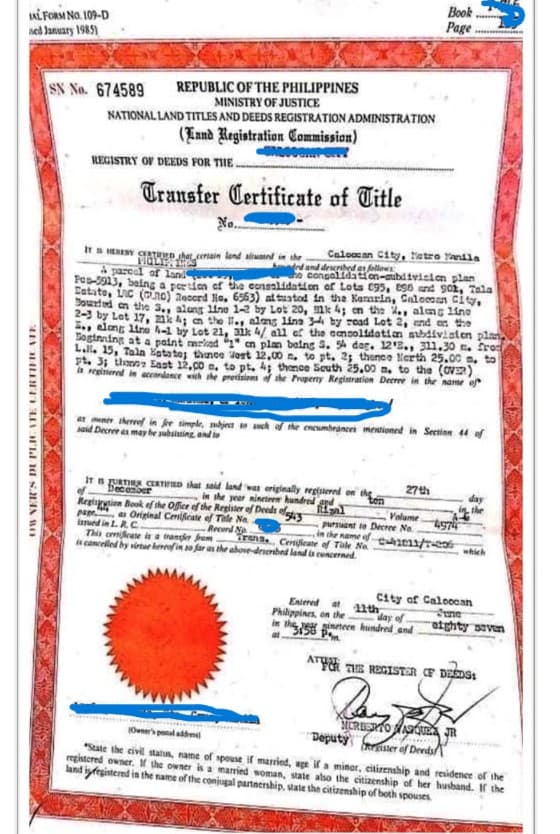
Buyer Beware: Illegal Real Estate Practices in the Philippines
What Is Title Fraud?
Title fraud occurs when a scammer fabricates or alters a Transfer Certificate of Title (TCT) or Original Certificate of Title (OCT) — the official documents that prove legal ownership of land in the Philippines — and uses these fake documents to "sell" a property they do not actually own.
The forged title is designed to look indistinguishable from a genuine one. Scammers obtain blank title forms, replicate the official format, and in some cases even bribe corrupt Registry of Deeds personnel to make the document appear in government records. The result: a buyer in good faith pays full price for a property they will never legally own.
---
## How the Scam Works
Title fraud usually follows a predictable pattern, though the details vary:
**Step 1 — The attractive selling price. The scammer lists a property — often land, a house and lot, or a condominium unit — at a price that seems like a bargain but is not so cheap as to raise immediate suspicion.
**Step 2 — The convincing setup. The seller presents what appears to be a complete set of documents: a TCT or OCT, a tax declaration, real property tax receipts, and even a Special Power of Attorney if they claim to represent the owner. Everything looks in order.
**Step 3 — Pressure to close quickly. Scammers often create urgency — other buyers are interested, the price will go up, the owner is going abroad. This pressure is designed to stop you from doing proper due diligence.
**Step 4 — The money changes hands. You pay a downpayment or the full purchase price. A deed of sale is signed.
**Step 5 — The discovery. When you try to transfer the title to your name at the Registry of Deeds, or when the real owner resurfaces, you learn the title was a forgery. The seller is gone. Recovering your money is an uphill battle.
---
Who Are the Targets?
Anyone can fall victim, but scammers most frequently target:
- OFWs and their families, who may be managing transactions remotely and under time pressure
- First-time homebuyers who are unfamiliar with the verification process
- Buyers from outside the area, who lack local knowledge of the property's history
- People buying from strangers online, where social media property listings offer little accountability
---
## The Red Flags to Watch For
No legitimate transaction should require you to skip verification. Be wary if:
- The price is noticeably below market value for the area
- The seller discourages you from visiting the Registry of Deeds to verify the title
- The seller is in a rush and pushing for immediate payment
- The title shows signs of alteration — smudges, inconsistent fonts, misaligned text
- The person selling the property is not the name on the title, and cannot provide a properly notarized Special Power of Attorney
- The property has no clear physical boundaries or is disputed by neighbors
---
## How to Protect Yourself: The Verification Checklist
1. Go to the Registry of Deeds in person.
The Registry of Deeds in the city or municipality where the property is located keeps the original copy of every title. Request a Certified True Copy of the title and compare it against what the seller gave you. They must match exactly — including the title number, technical description, and annotations.
2. Check for annotations and encumbrances.
A legitimate title will show a history of any mortgages, liens, or legal disputes in the annotations section. A suspiciously "clean" title with no history on an old property is a warning sign.
3. Verify tax declarations at the local Assessor's Office.
The name on the tax declaration should match the title. Check that real property taxes are paid and up to date.
4. Confirm with the Bureau of Internal Revenue (BIR).
If the property has changed hands before, capital gains tax and documentary stamp tax should have been paid. Ask for proof.
5. Conduct an ocular inspection.
Visit the property yourself. Talk to neighbors. Make sure there are no other claimants living on or using the land.
6. Hire a licensed real estate broker or lawyer.
A Professional Regulation Commission (PRC)-licensed real estate broker or a real estate lawyer can guide you through due diligence and spot irregularities you may miss. You may visit PRED.PH to find a real estate broker near you.
---
## What the Law Says
Title fraud is a criminal offense in the Philippines. Perpetrators can be charged with Estafa under the Revised Penal Code, which carries a prison term of up to 20 years, depending on the amount defrauded. Falsification of public documents — which includes forging a land title — carries a separate penalty of imprisonment under the Revised Penal Code.
If you are a victim, you may file a complaint with the National Bureau of Investigation (NBI) or the Philippine National Police (PNP), and pursue both criminal and civil cases to recover damages.
However, prevention is far better than litigation. Court cases in the Philippines can take years, and recovering money from a scammer who has fled is rarely straightforward. The best protection is rigorous verification before you pay a single peso.
---
## The Bottom Line
A land title is only as trustworthy as your due diligence. In a country where land disputes and documentation irregularities are not uncommon, verifying every document through the proper government channels is not optional — it is essential. Never let urgency, a charming seller, or a low price rush you into skipping this step.
In the next article in this series, we look at the double-sale scam — where the same property is sold to two different buyers at the same time — and how courts determine who really owns it.
---
---
This article is for informational purposes only and does not constitute legal advice. Consult a licensed attorney for guidance on specific situations.
Philippine Real Estate Directory — in your pocket.
Download the app now
Browse property listings, verify licensed professionals, save favourites, and send inquiries — all in one trusted platform.


Available on the App Store for iPhone and iPad, and on Google Play for Android.
Licensed professionals
Browse listings and profiles from credential-reviewed practitioners.
Search on the go
Find properties, professionals, news, and wanted inquiries anytime.
Save favourites
Keep a shortlist and revisit listings anytime.