How Real Estate Brokers Can Be More Productive in a Slow Market
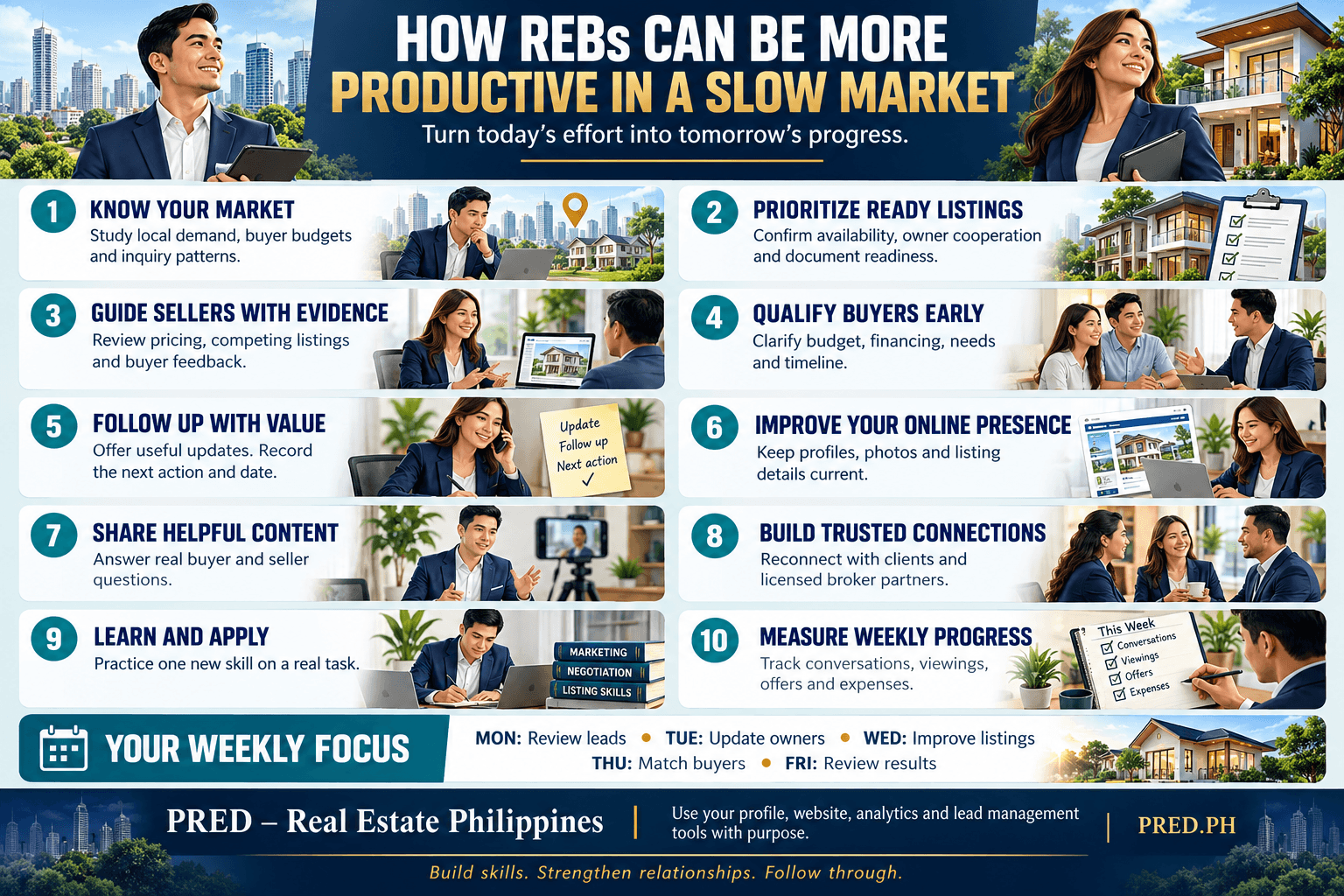
How Real Estate Brokers Can Be More Productive in a Slow Market
Turn today’s effort into tomorrow’s progress.
A slow real estate market can test even an experienced Real Estate Broker (REB). Inquiries may be fewer, buyers may take longer to decide, and sellers may resist adjusting their expectations. You can spend an entire day answering messages and posting advertisements without moving a single transaction forward.
But slower sales do not have to mean wasted days.
For REBs, productivity means using time purposefully: improving the quality of your listings, helping clients make informed decisions, strengthening relationships, and building a practice that can sustain you through changing market conditions.
Ask yourself: “Is what I am doing today helping me build a stronger professional practice tomorrow?”
1. Understand what is slow in your market
Do not assume that every location, property type, and price range is moving at the same pace.
National indicators provide context. The Bangko Sentral ng Pilipinas’ Residential Property Price Index, for example, tracks residential price changes using bank housing loan data. It is useful background, but it does not tell you how quickly a particular listing in your neighborhood will sell.
Study your own inquiries and transactions:
Which properties attract qualified buyers?
What budgets do buyers actually have?
Which listings receive attention but no viewing requests?
What concerns repeatedly delay decisions?
Are rental inquiries more active than purchase inquiries?
Use these observations to decide where to concentrate your effort. A broker who understands a specific market can give more useful guidance than one who simply repeats that “the market is slow.”
2. Prioritize listings that are ready to move forward
A large inventory is not automatically a productive inventory.
Review each listing for current availability, owner cooperation, pricing, authority to market, document readiness, and viewing access. Identify issues that could delay a transaction and communicate them accurately.
Then organize your inventory into three groups:
Ready to market: Current information, cooperative owner, workable viewing arrangements, and a clear path toward a transaction.
Needs improvement: Missing information, weak photos, unresolved pricing expectations, or documents requiring attention.
On hold: Unconfirmed availability, unclear authority, or owners who are not ready to proceed.
Focus your daily marketing on the first group. Set specific tasks for the second. Avoid repeatedly spending time and money on listings that cannot progress.
3. Help sellers respond to evidence
When a property receives little interest, reposting the same advertisement may not solve the problem.
Arrange a seller review. Discuss comparable properties, inquiry quality, viewing feedback, competing inventory, and how long the listing has been available. Distinguish advertised asking prices from verified transaction prices whenever possible.
Explain the choices clearly: improve presentation, reconsider the asking price, adjust workable terms, or reassess the timing of the sale.
You might say:
“We have received inquiries, but buyers consistently raise concerns about the price compared with available alternatives. Let us review those properties and decide what adjustment would give your listing a stronger position.”
Your role is to help the owner make an informed decision. Avoid promising a quick sale or recommending a price reduction without supporting evidence.
4. Qualify buyers before investing in viewings
A viewing requires preparation, travel, coordination, and time. Make it purposeful.
Before scheduling, understand the buyer’s preferred location, intended use, budget, payment method, target timeline, and essential requirements. Find out who participates in the decision.
For buyers considering financing, encourage an early discussion with their chosen lender. Present affordability estimates with clear assumptions and avoid treating an estimated loan amount as an approval.
Qualification should feel like assistance, not interrogation. The aim is to recommend suitable properties and prevent avoidable disappointments.
Three well-matched options can be more useful than twenty unrelated listings.
5. Replace random follow-ups with useful conversations
“Interested pa po?” gives a client little reason to respond.
A stronger follow-up brings relevant information:
“You mentioned that parking and access to your workplace were priorities. I have shortlisted two properties that meet those requirements. Would you like a comparison before deciding whether to view?”
For every active lead, record:
What the client needs.
What is preventing the next decision.
The next agreed action.
When you should follow up.
Respect the client’s preferred frequency of communication and any request to stop receiving messages. Consistency builds trust when it is helpful and considerate.
6. Improve your digital presence
Use quieter periods to make your online information clearer and easier to find.
Review your professional profile, contact details, service area, listing descriptions, photos, and property availability. Include material details that help buyers decide whether to inquire.
A useful listing answers practical questions: Where is it? How large is it? What is the price? What is included? What limitations should the buyer know?
For brokers using PRED – Real Estate Philippines, keep your profile and available listings current. Use your website or subdomain as an organized destination for interested clients, and use analytics and lead management tools to guide follow-through.
Technology becomes productive when it supports a routine: publish accurate information, review responses, and take the next action.
7. Create content that answers real client questions
Educational content gives people a reason to remember you before they are ready to transact.
Choose questions you hear repeatedly:
What should buyers prepare before viewing?
How can sellers prepare their property for marketing?
What should an OFW buyer verify before sending money?
What costs should buyers discuss before committing?
How do different neighborhoods fit different household needs?
One clear, useful article can support several conversations. Share it when it answers a client’s concern, and keep its information current.
Show your knowledge through practical explanations and careful research. Avoid exaggeration, unsupported investment claims, and promises of guaranteed returns.
8. Strengthen professional relationships
Reconnect with previous clients and trusted licensed brokers. Ask about their current requirements and look for appropriate opportunities to cooperate.
In co-brokerage work, clarify responsibilities, client handling, authority, and commission arrangements in writing before misunderstandings arise. Share client information only with appropriate permission.
Stay within the scope of your professional credentials and refer matters requiring other expertise to qualified professionals.
A reliable network helps you solve client problems more efficiently—and reliability is something you can build even when transactions are slow.
9. Learn one skill and apply it immediately
Training becomes productive when it changes your work.
Choose a skill that addresses a current weakness: listing presentation, negotiation, photography, client qualification, document organization, or digital tools.
Then apply it to a real task.
After learning about listing descriptions, rewrite one listing. After a negotiation lesson, prepare questions for an upcoming seller meeting. After learning a lead management tool, organize your active prospects.
AI can help draft descriptions, organize notes, and prepare checklists. Verify its output and protect confidential client information.
Learn, apply, review, improve.
10. Measure progress every week
Closings matter, but they may not happen every week. Track the activities that help transactions advance.
Here is a sample routine to adapt to your workload:
Day
Main focus
Useful output
Monday
Review leads and inventory
Priorities and next actions
Tuesday
Speak with owners
Updated information and pricing discussions
Wednesday
Improve listings and content
Better presentation and useful client guidance
Thursday
Match buyers and properties
Qualified shortlists and viewing arrangements
Friday
Review results and relationships
Follow-ups, referrals, and next week’s plan
Review qualified conversations, viewings, offers, listing improvements, and stalled opportunities. If inquiries do not lead to viewings, examine matching and qualification. If viewings do not lead to offers, investigate price, condition, suitability, and buyer readiness.
Also review expenses. Calculate whether subscriptions, advertising, travel, and other costs are producing useful results. Keep a cash-flow plan that allows for irregular commission income.
A slow market does not guarantee success for the busiest broker. It rewards purposeful work: accurate information, sensible priorities, useful communication, and dependable follow-through.
You may not control when a client decides to buy or sell. You can control how prepared you are to help when that decision comes.
Turn today’s effort into tomorrow’s progress. Build the skills, relationships, and systems that make your professional practice stronger—one deliberate action at a time.
Philippine Real Estate Directory — in your pocket.
Meeting a broker today? Check them on the spot.
The free PRED app puts the directory in your pocket. Verify a broker in the middle of a tripping, save listings you like, and send inquiries to licensed professionals anywhere in the Philippines.


Available on the App Store for iPhone and iPad, and on Google Play for Android.
Licensed professionals
Browse listings and profiles from credential-reviewed practitioners.
Search on the go
Find properties, professionals, news, and wanted inquiries anytime.
Save favourites
Keep a shortlist and revisit listings anytime.