Loopholes in Philippine Real Estate: Where the System Leaves Buyers and Sellers Exposed
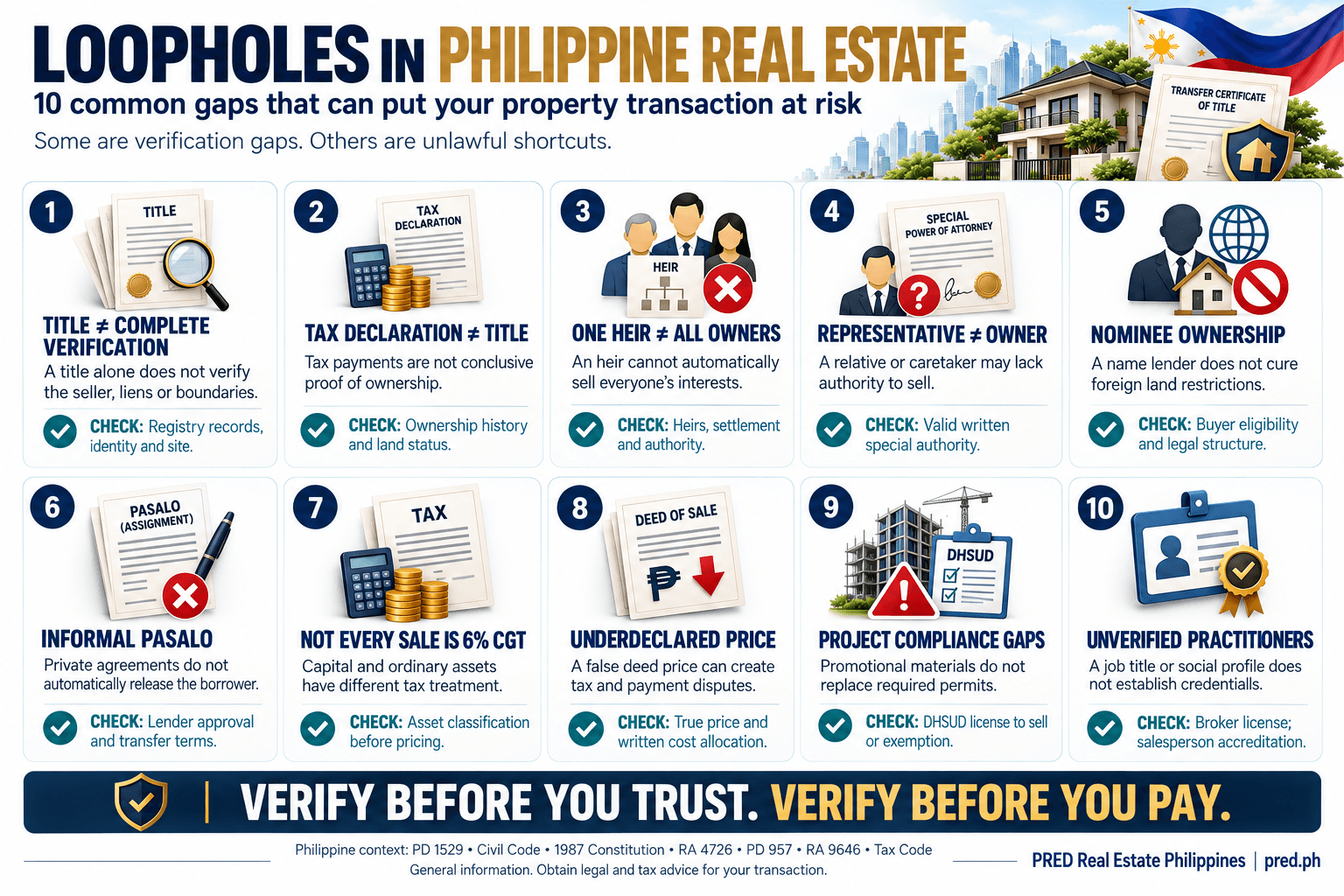
Loopholes in Philippine Real Estate: Where the System Leaves Buyers and Sellers Exposed
A closer look at property ownership, taxation, and the gaps that enable risky transactions.
“May titulo naman.”
“Notarized na ang deed.”
“Assume balance lang.”
“Tax declaration is enough.”
These assurances can make a property transaction sound simple. Yet each can hide a problem that becomes expensive to resolve after money changes hands.
In Philippine real estate, use the word “loophole” carefully. Some arrangements are lawful options with specific requirements. Others exploit weak verification, incomplete records, or delayed enforcement. Still others are outright violations presented as ordinary business practice.
Understanding the difference matters. A practice does not become legal simply because many people do it.
1. The gap between a title and a fully verified transaction
The Philippines uses the Torrens system of land registration. Certificates of title are central to establishing registered ownership, while registering transactions protects rights against third persons under the Property Registration Decree (Presidential Decree No. 1529).
But a seller's title is only the first step in verification.
A buyer should confirm that the document matches the Registry of Deeds record, that the seller is the registered owner or a properly authorized representative, and that mortgages, adverse claims, or other annotations do not affect the transaction.
The property on paper must also match the property on the ground. An attractive vacant lot may have occupants, disputed boundaries, or access problems that a title photograph won't explain.
Practical protection: Obtain a recent certified true copy independently, review its annotations, verify the seller’s identity and authority, and inspect the property. Where boundaries or access are uncertain, involve a licensed geodetic engineer and legal counsel.
2. Tax declarations presented as proof of ownership
A tax declaration and real property tax receipts can support a claim of possession. They are not conclusive proof of ownership. The Supreme Court has repeatedly recognized this distinction.
The danger arises when a buyer hears: “Ako ang nagbabayad ng amilyar, kaya akin ito.”
Payment of taxes does not, by itself, establish that the taxpayer owns the land or can convey a valid title. Nor should a buyer assume that untitled land can automatically be titled.
Practical protection: For untitled property, investigate the seller’s chain of rights, the land’s legal classification, competing claims, and the actual registration requirements. Treat “puwedeng patituluhan” as a claim requiring verification.
3. An inherited property sold as though one heir owns everything
Family property often remains in the name of a deceased parent or grandparent. Problems arise when one family member negotiates the sale without establishing the rights and participation of the other heirs.
Under Article 493 of the Civil Code, a co-owner may generally dispose of their undivided interest. That does not automatically give them authority to sell everyone else’s interests or guarantee ownership of a particular physical portion before partition.
For example, an heir’s statement that “the front half is mine” may reflect a family understanding that has never been legally documented.
The practical protection: Establish the heirs, the status of estate settlement, the seller’s actual interest, and the authority needed for the intended sale. A buyer seeking the entire property should not rely on one heir’s verbal promise to secure everyone else’s signature later.
4. A representative’s authority treated as unlimited
Being a relative, caretaker, or trusted associate does not automatically authorize someone to sell property.
The Civil Code requires written authority for an agent to sell land and special authority for specified acts involving ownership of immovable property. The scope of that authority matters. Authority to negotiate should not simply be assumed to include authority to sign the deed or receive the purchase price.
Practical protection: Verify the special power of attorney, confirm its scope and continued validity, and communicate directly with the owner through an independently verified channel. For documents executed abroad, check the applicable authentication or apostille requirements.
5. Foreign ownership restrictions disguised through nominee arrangements
The Constitution restricts the transfer of private land to persons or entities qualified to acquire it, subject to recognized exceptions, including hereditary succession. It also provides separately for natural-born Filipinos who have lost Philippine citizenship.
This creates a market for supposed shortcuts: a Filipino “name lender,” a private agreement claiming the foreign financier is the real owner, or a corporation whose actual arrangement conflicts with nationality requirements.
Such arrangements should never be promoted as assured ownership solutions. Financing a purchase does not automatically confer a legally enforceable ownership right.
Condominiums require a separate analysis. The Condominium Act regulates transfers related to common-area ownership and the nationality requirements that apply to a condominium corporation. The familiar “40% foreign ownership” explanation needs to be checked against the project’s actual structure and records.
The practical protection: Determine the buyer’s legal eligibility before accepting money or proposing an ownership structure.
6. “Assume balance” arrangements that leave the original borrower exposed
In an informal pasalo, the incoming buyer may pay the original buyer and continue the monthly installments while the lender’s records remain unchanged.
The Civil Code requires the creditor’s consent to substitute a debtor. A private agreement between the outgoing and incoming buyers therefore does not automatically release the original borrower from the loan.
This can leave both parties vulnerable. The original borrower remains exposed if payments stop, while the incoming buyer may discover that paying installments does not automatically produce an approved transfer of the loan or title.
The practical protection: Obtain the lender’s—and, where applicable, developer’s—written requirements and approval. Document the outstanding balance, assignment restrictions, transfer conditions, and consequences of default before paying the outgoing buyer.
7. The misconception that every sale is subject to 6% capital gains tax
One of the most costly oversimplifications is: “Lahat ng bentahan ng property, 6% CGT.”
The familiar 6% capital gains tax applies to qualifying sales of Philippine real property classified as capital assets, generally using the higher of the gross selling price or the applicable fair market value. It is imposed on presumed gain, rather than simply on the seller’s actual profit.
Property classified as an ordinary asset is taxed differently. The BIR’s Revenue Memorandum Circular No. 99-2023 discusses expanded withholding tax, documentary stamp tax, and the relevant income tax and VAT treatment. Classification depends on the facts, including the seller’s business and the property’s use.
The practical protection: Determine the asset classification before quoting a final net price. A property used in business or held for sale should not automatically receive the tax treatment used for a privately held capital asset.
8. Underdeclaration presented as a harmless way to save taxes
A seller and buyer may be encouraged to put a lower price in the deed while keeping the actual payment in a separate agreement.
This is not a dependable tax-saving loophole. The capital gains tax rules already compare the selling price with prescribed fair market value. A falsely stated consideration can also create tax exposure and inconsistencies between the deed, payment records, and the parties’ later claims.
A separate problem is loosely advertised “all-in” prices: buyers may not know whether taxes, registration expenses, arrears, or other charges are included.
Practical protection: Record the genuine transaction and prepare a written expense allocation. Distinguish the person legally liable for a tax from the party who has contractually agreed to shoulder its economic cost.
9. Project marketing that gets ahead of regulatory compliance
An attractive subdivision plan, a reservation receipt, or a developer’s corporate registration should not be treated as a substitute for project compliance.
Under PD 957, covered subdivision and condominium projects generally require a license to sell, subject to statutory exemptions. The law also addresses misleading advertising and requires advertisements to reflect the facts.
The vulnerability appears when buyers pay based on a project name without checking whether the authorization covers the actual phase, lot, building, or unit being offered.
The practical protection: Verify the relevant project registration and license to sell with DHSUD, or obtain a clear explanation of the applicable exemption. Read reservation and purchase documents before paying, including conditions on financing, completion, cancellation, and refunds.
10. Unlicensed brokerage hidden behind another job title
“Property consultant,” “marketing partner,” and “referral agent” can sound reassuring. The legal question is what the person actually does.
RA 9646, or the Real Estate Service Act, regulates real estate service practice and provides specific exemptions. It also requires real estate salespersons to be accredited and to work under a broker’s direct supervision and accountability. Salespersons are lawful participants in the profession when they meet these requirements.
An owner selling their own property and a person repeatedly negotiating other people’s properties for compensation should not automatically be treated as having the same legal position.
The practical protection: Verify the broker’s credentials and, for a salesperson, the accreditation and supervising broker. A social media profile or membership in a property group is not enough to verify.
Closing the gaps requires more than collecting documents
These examples reveal a recurring weakness: people often verify only one part of a transaction.
They check the title but overlook authority. They confirm the seller’s identity but ignore co-ownership. They agree on the price before determining taxes. They pay a reservation fee before checking compliance with project regulations.
A sound transaction connects all these elements: the property, the owner, the authority to sell, the buyer’s eligibility, the tax treatment, and the process for completing the transfer.
System reforms also matter. RA 12001 seeks greater consistency and transparency in real property valuation. Its implementation should be checked for the relevant locality and transaction; parties should avoid assuming valuation changes have taken effect uniformly everywhere.
For brokers, the professional responsibility is to recognize unresolved questions and bring them to the right specialist before the client commits. For buyers and sellers, the strongest protection is a willingness to pause when a material fact remains unverified.
Verify before you trust—and verify before you pay.
This article provides general information on Philippine real estate. The legal and tax treatment of a particular transaction depends on its facts and the rules applicable at the time.
Philippine Real Estate Directory — in your pocket.
Meeting a broker today? Check them on the spot.
The free PRED app puts the directory in your pocket. Verify a broker in the middle of a tripping, save listings you like, and send inquiries to licensed professionals anywhere in the Philippines.


Available on the App Store for iPhone and iPad, and on Google Play for Android.
Licensed professionals
Browse listings and profiles from credential-reviewed practitioners.
Search on the go
Find properties, professionals, news, and wanted inquiries anytime.
Save favourites
Keep a shortlist and revisit listings anytime.