PASALO or “Assume Balance”: Don’t Pay for a Property You May Never Own
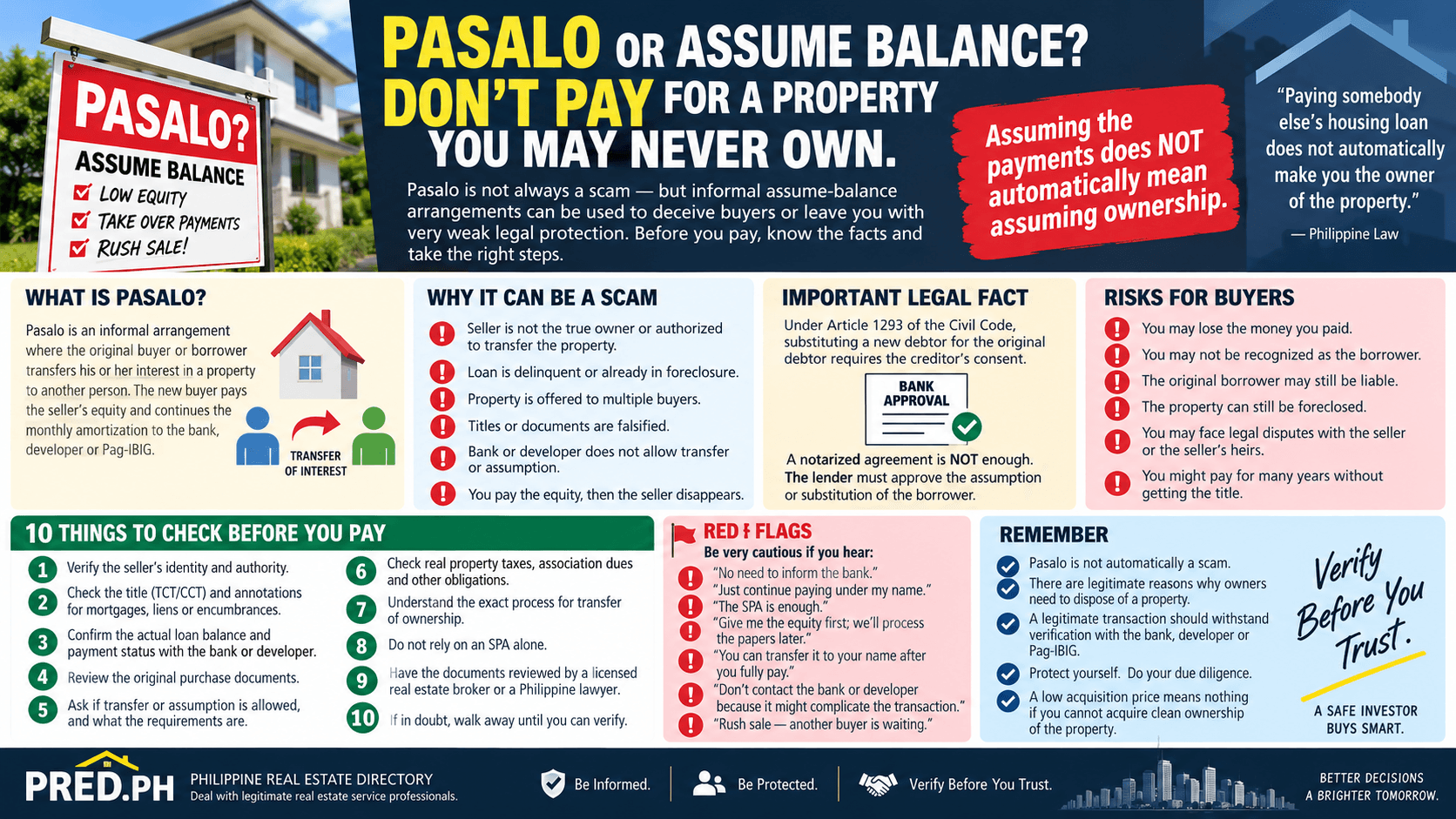
A Buyer’s Guide to the Risks of Buying Mortgaged Property in the Philippines
You see an attractive property advertised online:
“PASALO! Assume balance only. Rush sale!”
The seller explains that the house is already partially paid. You only need to reimburse the seller’s equity, take possession of the property, and continue paying the monthly amortization to the bank, developer, or Pag-IBIG.
It can sound like a bargain.
But before handing over your money, understand one very important fact:
Paying somebody else’s housing loan does not automatically make you the owner of the property.
A legitimate assumption or transfer can be done, but an informal “pasalo” arrangement can expose a buyer to serious financial and legal risks.
What Is “Pasalo”?
“Pasalo” is an informal term commonly used when the original buyer or borrower transfers his or her interest in a property to another person.
Typically:
Original Buyer/Borrower → New Buyer
The new buyer pays the original buyer an agreed amount representing the seller’s equity or previous payments and then continues paying the remaining installments.
But not all pasalo transactions are legally the same.
The property might still be under a Contract to Sell with a developer, or the title might already be in the seller’s name but mortgaged to a bank or Pag-IBIG.
The distinction matters because the seller may not yet have an unrestricted property that can simply be handed over to another person.
The Biggest Misunderstanding: “I’m Paying the Loan, So the Property Is Mine.”
Not necessarily.
Suppose Juan obtained a housing loan from a bank. Juan later offers the property to Maria under a pasalo arrangement.
Maria pays Juan ₱1 million for his equity and agrees to continue Juan’s monthly amortization.
Maria may even move into the house.
But if the bank never formally approved Maria as the replacement borrower, Juan may remain the borrower recognized by the bank.
Article 1293 of the Civil Code provides that substituting a new debtor for the original debtor cannot be done without the creditor’s consent.
Therefore, an agreement between Juan and Maria does not, by itself, necessarily substitute Maria as the bank’s borrower.
A Notarized Agreement Is Not the Same as Lender Approval
This is another dangerous misconception.
A seller may tell you:
“Don’t worry. We have a notarized Deed of Sale, Deed of Assignment and SPA.”
Those documents may establish certain rights and obligations between the buyer and seller.
But notarization alone does not automatically make the buyer the recognized borrower of the bank or financing institution.
The lender is a separate party.
If the transaction involves taking over somebody else's loan, the buyer should determine whether the lender permits the arrangement and what its formal requirements are.
How a Pasalo Can Turn Into a Scam
The greatest danger occurs when buyers hand over substantial money before independently verifying the property, seller, loan and transfer procedure.
Imagine paying ₱800,000 as “equity” and then discovering that:
the seller is not actually authorized to transfer the property;
the account is already seriously delinquent;
foreclosure proceedings have started;
the remaining loan is much higher than represented;
the seller has already offered the same property to another buyer;
the title has another lien, adverse claim or encumbrance;
the developer prohibits assignment without approval;
the bank does not recognize the assumption;
the person offering the property is not the registered owner or borrower; or
the documents shown to you are falsified.
By the time these problems are discovered, the person who received the buyer's money may have disappeared.
The Property Is Mortgaged—What Does That Mean?
A mortgage does not simply disappear because the property changes hands.
Philippine Supreme Court jurisprudence recognizes that the sale or transfer of mortgaged property does not, by itself, release the mortgage. A purchaser who acquires property knowing that it is mortgaged takes it subject to that encumbrance.
This means there are actually two important questions:
Who owns or has rights over the property?
and
Who owes the lender the money?
Those questions should never be treated as though they are automatically the same.
A private arrangement between buyer and seller may transfer certain rights between them without necessarily making the buyer the lender's recognized borrower.
What If the Buyer Faithfully Pays Every Month?
That still does not solve every problem.
Imagine paying the amortization for five or ten years while the account and important documents remain under another person's name.
What happens if the original borrower:
dies?
becomes uncooperative?
leaves the country?
has disputes with his heirs?
refuses to execute the necessary documents?
has creditors who pursue his assets?
Or what happens when the buyer finally asks the lender to release the documents and discovers that the lender never recognized the private arrangement?
This is why possession plus payment should never be confused with a clean transfer of ownership.
Before Paying for a Pasalo Property
A buyer should conduct due diligence before paying the seller's equity, reservation money or any substantial amount.
At minimum, independently verify:
1. The seller's identity
Confirm that the person offering the property is really the registered owner, original buyer, borrower, or person legally authorized to transact.
2. The title
Obtain and examine an updated certified true copy of the TCT or CCT, where applicable. Check the registered owner and annotations for mortgages, liens, adverse claims and other encumbrances.
3. The actual loan
Do not simply accept screenshots, receipts or the seller's statement about the remaining balance.
With proper authorization and through the appropriate lender procedure, establish the actual outstanding obligation, payment status and applicable requirements.
4. The original purchase documents
Review the Contract to Sell, Deed of Sale, loan agreement, real estate mortgage and other relevant documents.
5. Whether transfer or assumption is permitted
Ask the developer, bank or financing institution directly about its requirements.
6. Taxes, association dues and other obligations
Check whether real property taxes, condominium dues, homeowners' association dues and other charges are current.
7. The procedure for eventual transfer of ownership
Do not settle for:
“After you finish paying, we'll transfer it to you.”
Ask exactly how that will happen, what documents will be required, who must sign them, what approvals are necessary, and what happens if one of the parties dies or becomes unavailable before then.
Never Rely on an SPA Alone
A Special Power of Attorney can be useful in legitimate transactions, but buyers should not treat an SPA as a substitute for ownership, lender approval or proper conveyance.
An SPA essentially gives another person authority to perform specified acts on behalf of the principal.
It does not magically erase a mortgage.
It does not automatically transfer the title.
And it does not automatically substitute the buyer as borrower.
The Safer Way to Handle an Assume-Balance Transaction
If a property is mortgaged, involve the lender.
Ask:
“Do you allow assumption or substitution of borrower for this particular loan, and what is your formal procedure?”
The incoming buyer may need to qualify under the lender's requirements. The lender may evaluate the buyer's income, creditworthiness and capacity to pay before approving any substitution or restructuring.
If the lender does not permit an assumption, ask a lawyer and the lender about other legitimate structures, such as settlement of the existing loan followed by release of the mortgage and properly documented transfer, or financing the purchase through a new loan.
The correct structure depends on the particular transaction.
RED FLAGS: Walk Away Until You Can Verify
Be extremely cautious when you hear:
“No need to inform the bank.”
“Just continue paying under my name.”
“The SPA is enough.”
“Give me the equity first; we'll process the papers later.”
“The title is with the bank, so there's nothing to check.”
“You can transfer it to your name after you've fully paid.”
“Rush sale—another buyer is waiting.”
And one of the biggest red flags:
“Don't contact the bank/developer because it might complicate the transaction.”
A legitimate transaction should withstand verification.
For Sellers: You Are Also at Risk
Pasalo is not only risky for the incoming buyer.
Suppose you are the original borrower and another person informally takes over your property.
You think:
“It's no longer my problem. He'll continue paying the loan.”
But if the lender never approved the substitution, you may still be the borrower legally responsible for the debt.
If the new buyer stops paying, the lender may pursue remedies under the loan and mortgage documents, including foreclosure where legally available.
So an undocumented pasalo can leave both buyer and seller exposed.
PASALO IS NOT AUTOMATICALLY A SCAM
This distinction is important.
Legitimate reasons may require an owner to dispose of a property before completing payment. Job loss, relocation, migration, financial problems, inheritance issues and changing family circumstances can all result in legitimate assume-balance transactions.
The danger is not the Filipino word “pasalo.”
The danger is an informal, unverified or unauthorized transaction where money changes hands without establishing exactly what rights are being transferred and whether the lender or developer recognizes the arrangement.
Before You Pay, Ask One Question
“If I give you my money today, what legally guarantees that I can eventually obtain ownership of this property?”
If the answer consists only of promises, screenshots, photocopies, an SPA or “trust me,” do not rush.
For a substantial real estate transaction, have an independent licensed real estate broker examine the documents and, when legal rights or contract drafting are involved, a Philippine lawyer. Verify directly with the developer, bank, Pag-IBIG or other financing institution as applicable.
VERIFY BEFORE YOU PAY. VERIFY BEFORE YOU TRUST.
A low acquisition price means little if you later discover you can't obtain clean ownership of the property.
PRED.PH — Philippine Real Estate Directory
Deal with legitimate real estate service professionals.
Be informed. Be protected. Verify before you trust.
Philippine Real Estate Directory — in your pocket.
Download the app now
Browse property listings, verify licensed professionals, save favourites, and send inquiries — all in one trusted platform.


Available on the App Store for iPhone and iPad, and on Google Play for Android.
Licensed professionals
Browse listings and profiles from credential-reviewed practitioners.
Search on the go
Find properties, professionals, news, and wanted inquiries anytime.
Save favourites
Keep a shortlist and revisit listings anytime.