Pre-Selling vs. RFO: Which Should You List/Buy First?
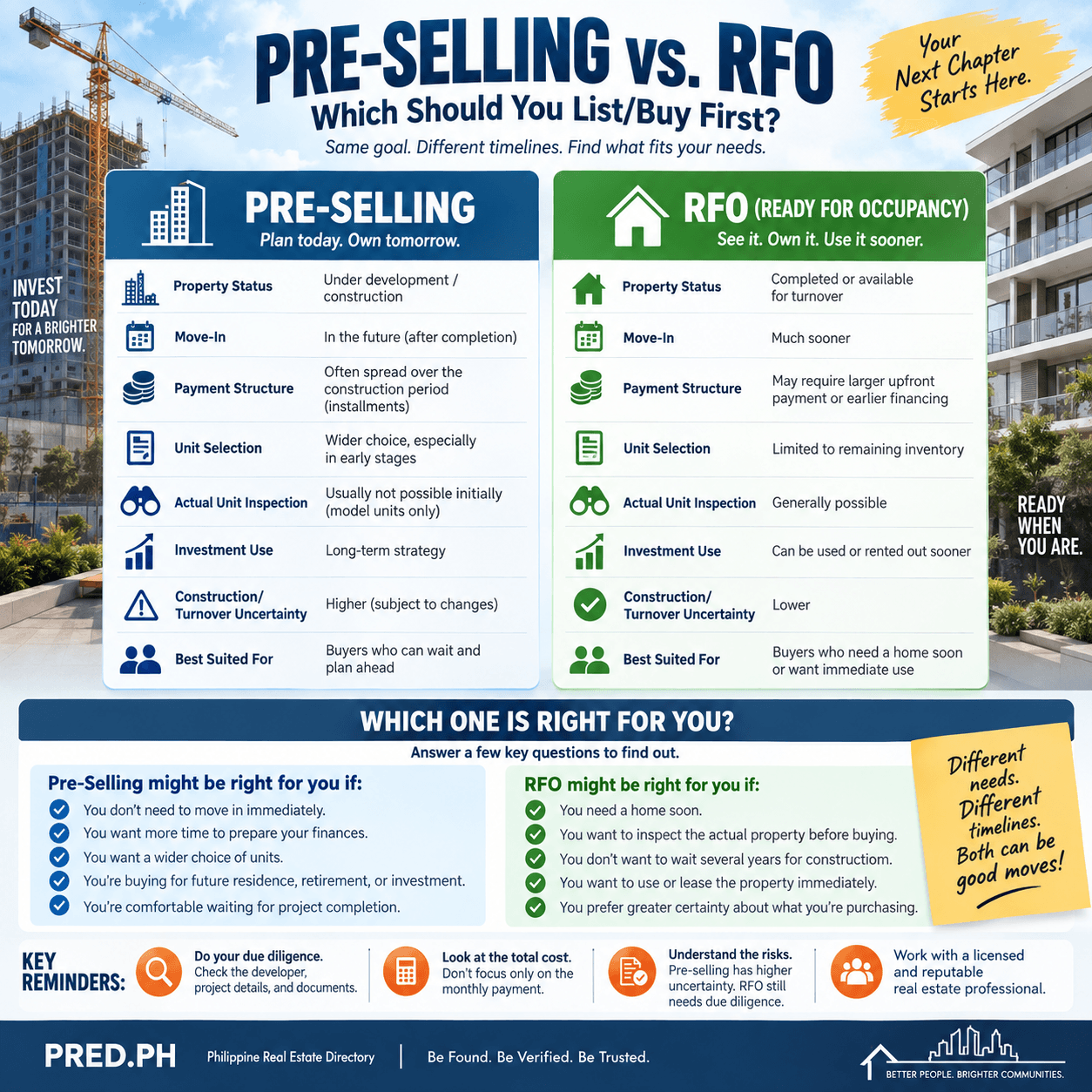
Pre-Selling vs. RFO: Which Should You List/Buy First?
When looking for a condominium, house-and-lot, or other developer project in the Philippines, buyers often encounter two choices: pre-selling and RFO (Ready for Occupancy).
Both can be good opportunities—but they serve very different needs.
For buyers, the right choice depends on when you need the property, how much you can afford now, your financing capacity, and whether you're buying for personal use or investment.
For real estate brokers, understanding these differences matters just as much. Instead of simply presenting whatever inventory is available, the better approach is to match the property to the client's objective.
So which should you buy—or list and promote—first?
What Is a Pre-Selling Property?
A pre-selling property is offered for sale before the project or unit is completed and ready for turnover. Depending on the development stage, construction may not yet have started or may already be underway.
One of its biggest attractions is the payment structure. Developers often offer installment arrangements for the down payment during construction, which can make the initial cash requirement easier to manage.
Pre-selling may be attractive to buyers who:
Do not need to move in immediately.
Want more time to prepare for the balance or financing.
Want a wider choice of available units during the earlier stages of a project.
Are buying for a future residence, retirement, or investment.
Are comfortable waiting for project completion and turnover.
However, buyers should remember an important principle:
You are buying something that is not yet fully completed.
That makes due diligence especially important.
Buyers should investigate the developer's track record, project details, permits and licenses, payment terms, turnover schedule, contract provisions, cancellation/refund conditions, association dues, and other charges.
A beautiful showroom and attractive payment plan should never replace proper verification.
What Is an RFO Property?
RFO means Ready for Occupancy.
The property is already completed—or sufficiently completed and available for turnover under the applicable terms—so the buyer can inspect the actual unit and move in much sooner after completing the purchase requirements.
This makes RFO particularly attractive to buyers who:
Need a home soon.
Want to inspect the actual property before buying.
Do not want to wait several years for construction.
Want to use the property immediately.
Plan to lease it out as soon as practicable.
Prefer greater certainty about what they are purchasing.
The trade-off is often financial.
Compared with an early-stage pre-selling purchase, an RFO property may require a larger immediate cash outlay or earlier financing. Discounts, financing arrangements, and payment terms vary significantly by developer and project, so buyers should compare total acquisition cost rather than assume one category is always cheaper.
Pre-Selling vs. RFO at a Glance
Factor
Pre-Selling
RFO
Property status
Under development/construction
Completed or available for turnover
Move-in
Future
Much sooner
Initial payment structure
Often spread over construction period
May require larger upfront payment/financing
Unit selection
Often wider at early project stages
Limited to remaining inventory
Actual unit inspection
Usually not possible initially
Generally possible
Investment use
Longer-term strategy
Potentially usable/rentable sooner
Construction/turnover uncertainty
Higher
Lower
Best suited for
Buyers who can wait
Buyers who need property sooner
So, Which Should a Buyer Choose First?
There is no universal answer.
The better question is:
“What are you buying the property for?”
If you're buying a home because you need somewhere to live soon, an RFO property will usually make more sense.
If you're planning three to five years ahead and want time to build up funds before turnover, a pre-selling property may be worth considering.
If you're buying primarily as an investment, don't automatically assume pre-selling is the better investment simply because the initial payment looks lower.
Look at the numbers.
Consider the total contract price, financing costs, expected turnover date, potential rental income, comparable resale prices, recurring expenses, taxes, association dues, and realistic appreciation potential.
Likewise, RFO shouldn't automatically be dismissed as “more expensive.” An RFO property that can generate rental income sooner may make financial sense for a particular investor.
Price alone doesn't determine investment quality.
For Brokers: Which Should You List or Promote First?
This is where professional real estate practice matters.
The answer should not be:
“Whichever gives me the highest commission.”
It should be:
“Whichever best fits my client's requirements.”
A professional broker should first understand the buyer.
Ask questions such as:
When do you need the property?
A buyer who needs to move within three months should not spend most of the meeting looking at projects scheduled for turnover years from now.
How much cash can you comfortably allocate now?
A buyer may like an RFO unit but not be prepared for its immediate cash requirements.
Will this be your home or an investment?
An end-user and an investor may evaluate exactly the same property very differently.
If it's an investment, what is your strategy?
Is the buyer looking for rental income, capital appreciation, resale, retirement use, or a combination?
Are you prepared for the financing obligation upon turnover?
This is especially important with pre-selling purchases. A manageable monthly down payment today does not necessarily mean the buyer will qualify for or comfortably carry the remaining balance later.
Don't Sell the Monthly Payment—Explain the Entire Commitment
One of the easiest ways to market pre-selling properties is to advertise a seemingly affordable monthly amount.
For example:
“Own a condo for only ₱XX,XXX per month!”
But that figure may represent only one part of the buyer's obligation.
A responsible real estate professional should help the client understand what happens before, during, and after the installment period.
What is the total contract price?
How much is the reservation fee?
How much is the down payment?
When is the balance due?
Will the balance be financed through a bank, Pag-IBIG where applicable, or another arrangement?
What additional charges may become payable?
And most importantly:
Can the buyer realistically afford the property when turnover arrives?
Helping a buyer answer those questions is far more valuable than simply showing an attractive monthly installment.
Pre-Selling Has Risks Buyers Should Understand
Pre-selling can offer opportunities, but buyers should enter with realistic expectations.
Construction and turnover schedules may change. Market conditions can change. Financing circumstances can change. A buyer's own income situation may change during a multi-year construction period.
There is also no guarantee that a property will appreciate by a particular amount.
Statements such as “guaranteed appreciation” or “you can easily resell this before turnover” should be treated carefully unless there is a legitimate contractual basis for such a guarantee.
Property investment always involves risk.
RFO Doesn't Mean “No Due Diligence”
Because an RFO property already exists, buyers sometimes become less cautious.
That can also be a mistake.
Before purchasing, investigate the actual unit and development.
Check the physical condition, title or ownership documentation as applicable, turnover status, association dues, parking arrangements, restrictions, utilities, building management, taxes and fees, and other obligations.
If the property is being purchased for rental purposes, investigate the actual rental market rather than relying only on projected rental figures.
Ask:
What are comparable units really renting for today?
That number is much more useful than an optimistic projection.
For Sellers and Brokers: Don't Mix the Message
Pre-selling and RFO appeal to different buyer motivations.
A pre-selling advertisement can emphasize:
Planning ahead. Payment flexibility. Choice of inventory. Long-term ownership or investment horizon.
An RFO advertisement can emphasize:
See it. Inspect it. Own it. Use it sooner.
When every property is marketed using the same generic phrases—“best investment,” “prime location,” “limited units,” “high appreciation”—the listing becomes less meaningful.
Good listings answer the buyer's real question:
“Why is this particular property suitable for me?”
The Best Listing Isn't Necessarily the Cheapest One
For brokers building their property inventory, there is another important lesson.
Don't collect listings simply because they're available.
Build an inventory that gives you choices for different types of buyers.
Ideally, your portfolio should include properties across different timelines, locations, price ranges, property types, and buyer objectives.
Then, instead of saying:
“This is what I have.”
You can say:
“Based on what you told me, these are the properties that fit your requirements.”
That is the difference between merely advertising property and providing professional real estate service.
A Simple Rule for Buyers
Think of it this way:
Buy Pre-Selling when TIME is on your side.
You can wait for completion, you understand the risks, you've studied the developer and project, and the payment structure fits your long-term financial plan.
Buy RFO when TIME matters.
You want to inspect the actual property, move in or use it sooner, or potentially start generating rental income earlier.
Neither is automatically better.
The better property is the one that fits your purpose, finances, timeline, and risk tolerance.
And a Simple Rule for Brokers
Don't begin with the inventory.
Begin with the client.
Understand the client's objective first.
Then present the appropriate property.
A licensed real estate professional isn't merely someone who knows what properties are available.
A professional should help buyers understand what they are buying, why they are buying it, what obligations come with it, and whether it fits their needs.
That is where professional advice creates value.
Before You Buy: Verify Who You're Dealing With
Whether you're purchasing a pre-selling property or an RFO property, verification should be part of your due diligence.
Know the developer. Understand the project. Read the documents. Understand the payment obligations.
And verify the real estate professional assisting you.
PRED.PH — Philippine Real Estate Directory
Be Found. Be Verified. Be Trusted.
Search for legitimate Philippine real estate professionals and make verification part of every property transaction.
Philippine Real Estate Directory — in your pocket.
Download the app now
Browse property listings, verify licensed professionals, save favourites, and send inquiries — all in one trusted platform.


Available on the App Store for iPhone and iPad, and on Google Play for Android.
Licensed professionals
Browse listings and profiles from credential-reviewed practitioners.
Search on the go
Find properties, professionals, news, and wanted inquiries anytime.
Save favourites
Keep a shortlist and revisit listings anytime.