PROTECT YOURSELF FROM REAL ESTATE IDENTITY THEFT SCAMS
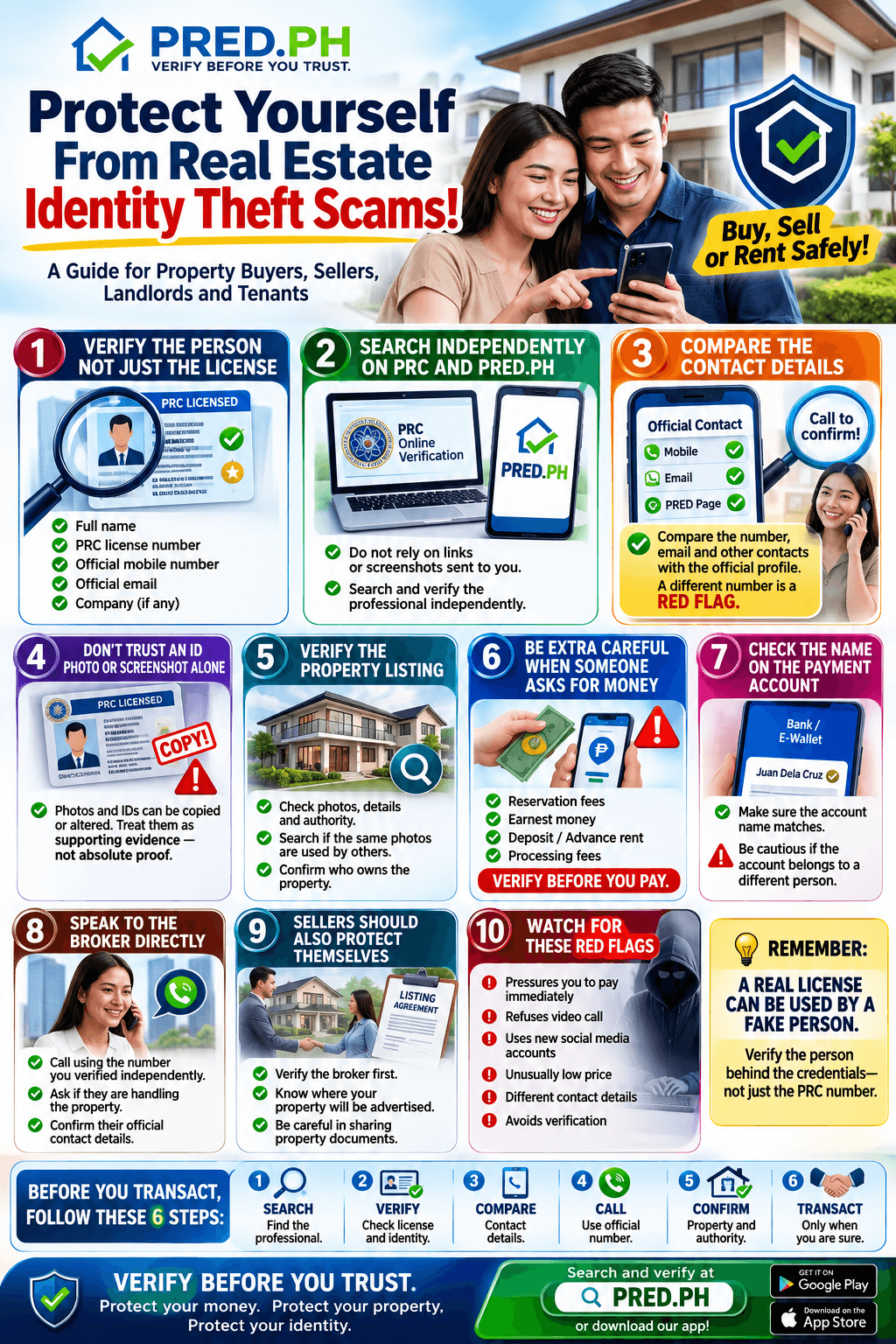
A Guide for Property Buyers, Sellers, Landlords and Tenants
Scammers are becoming more sophisticated. Some no longer pretend to be real estate professionals using fictitious names. Instead, they steal the name, photograph, PRC number, credentials, listings and even advertisements of legitimate real estate brokers and use them to gain the public’s trust.
This creates a dangerous situation: the credentials you see may be genuine, but the person using them may be fake.
Before discussing a property, providing documents, or sending money, take these precautions.
1. VERIFY THE PERSON — NOT JUST THE LICENSE
Finding a valid PRC number is not enough.
A scammer may be using the name and PRC number of a real licensed professional.
Verify that the person communicating with you is actually the professional whose credentials are being presented.
Ask for the broker’s:
· Full name
· PRC license number
· Official mobile number
· Official email address
· Professional profile or website
· Brokerage or company affiliation, when applicable
Then independently verify the information.
2. SEARCH FOR THE PROFESSIONAL INDEPENDENTLY
Do not rely solely on links, screenshots, identification cards or credentials sent to you by the person you are dealing with.
Search for the professional independently.
You may check the professional through the PRC online verification system and search for the professional on PRED.PH.
If you find an official contact number, call it directly to confirm you are dealing with the real professional.
3. COMPARE THE CONTACT DETAILS
This is extremely important.
A scammer can copy:
A broker’s name.
A broker’s photograph.
A PRC number.
A property advertisement.
Property photographs.
Even an entire social media post.
But the scammer normally needs to provide their own telephone number, Messenger account, email address or payment account to communicate with you and receive your money.
Compare these details with the professional’s independently verified contact information.
A DIFFERENT CONTACT NUMBER IS A RED FLAG.
Do not send money until you have confirmed the person’s identity.
4. NEVER TRUST AN ID PHOTO OR SCREENSHOT ALONE
A photograph of a PRC ID does not necessarily prove that the person sending it is the person named on the ID.
Digital images can be copied, altered and reused.
Treat identification documents as supporting evidence—not absolute proof of identity.
5. VERIFY THE PROPERTY LISTING
Scammers frequently copy legitimate property advertisements and repost them under their own contact information.
If you see a property online:
· Search for other advertisements using the same property photos.
· Check whether different names or telephone numbers appear.
· Ask who owns the property.
· Ask about the broker’s authority to offer the property.
· Confirm important information before paying anything.
A professional-looking advertisement does not automatically mean it is legitimate.
6. BE EXTRA CAREFUL WHEN SOMEONE ASKS FOR MONEY
Exercise additional caution when asked for:
· Reservation fees
· Earnest money
· Rental deposits
· Advance rent
· Processing fees
· Documentation fees
· “Viewing reservation” payments
· Any payment intended to supposedly secure the property
VERIFY BEFORE YOU PAY.
Confirm who is receiving the money, why the payment is required, and whether that person is authorized to receive it.
Be particularly cautious when you are pressured to send money immediately because “another buyer is waiting.”
7. CHECK THE NAME ON THE PAYMENT ACCOUNT
Before transferring money through a bank, e-wallet or other payment channel, examine the recipient’s name.
If the account belongs to a completely different person, stop and ask why.
Do not accept explanations such as:
“That’s my assistant’s account.”
“That’s my spouse’s GCash.”
“Our company account isn’t working.”
without independent verification.
8. SPEAK TO THE BROKER DIRECTLY
If there is any doubt, call the broker using a telephone number you obtained independently, rather than simply calling the number provided by the person who contacted you.
Ask:
“Are you the person communicating with me about this property?”
“Is this your official mobile number/account?”
“Are you handling this particular property?”
“Did you authorize this person to represent you?”
A one-minute verification call could prevent a substantial financial loss.
9. SELLERS SHOULD ALSO PROTECT THEMSELVES
Property owners are also vulnerable.
A person may pretend to be a legitimate broker, obtain your property photographs and documents, and advertise your property without your knowledge.
Before providing documents or authorizing someone to market your property:
· Verify the broker’s identity.
· Verify the broker’s license.
· Confirm the broker’s contact information.
· Clearly establish the authority being given.
· Know where your property will be advertised.
· Avoid unnecessarily distributing sensitive property and personal documents.
If possible, watermark property photographs or documents that are being provided for a specific purpose.
10. WATCH FOR THESE RED FLAGS
Be cautious when someone:
· Refuses a video call or personal meeting without a reasonable explanation.
· Uses credentials that do not match their contact details.
· Communicates only through newly created social media accounts.
· Pressures you to pay immediately.
· Offers a property at an unusually low price.
· Requests payment before proper verification.
· Sends only screenshots as proof of identity.
· Requests payment to an unrelated person’s account.
· Gives inconsistent information about the property.
· Becomes defensive when you ask to verify their identity.
· Claims that verification is unnecessary because they already sent their PRC ID.
A legitimate professional should understand why clients want to verify who they are dealing with.
REMEMBER:A REAL LICENSE CAN BE USED BY A FAKE PERSON.
Do not simply ask:
“Is this PRC number legitimate?”
Also ask:
“Is the person I am talking to really the owner of these credentials?”
BEFORE YOU PAY, VERIFY.1. SEARCH
Search for the real estate professional independently.
2. VERIFY
Confirm the professional’s license and identity.
3. COMPARE
Compare the telephone number, email and other contact information.
4. CALL
Call the professional using independently verified contact information.
5. CONFIRM
Confirm the property and the authority of the person offering it.
6. ONLY THEN SHOULD YOU TRANSACT.
PRED.PH — VERIFY BEFORE YOU TRUST.
Don’t verify only the credentials. Verify the person behind them.
Protect your money.
Protect your property.
Protect your identity.
Before you transact with someone claiming to be a real estate professional, search and verify.
Philippine Real Estate Directory — in your pocket.
Download the app now
Browse property listings, verify licensed professionals, save favourites, and send inquiries — all in one trusted platform.


Available on the App Store for iPhone and iPad, and on Google Play for Android.
Licensed professionals
Browse listings and profiles from credential-reviewed practitioners.
Search on the go
Find properties, professionals, news, and wanted inquiries anytime.
Save favourites
Keep a shortlist and revisit listings anytime.