REAL ESTATE SERVICE PROFESSIONALS! PROTECT YOUR PROFESSIONAL IDENTITY
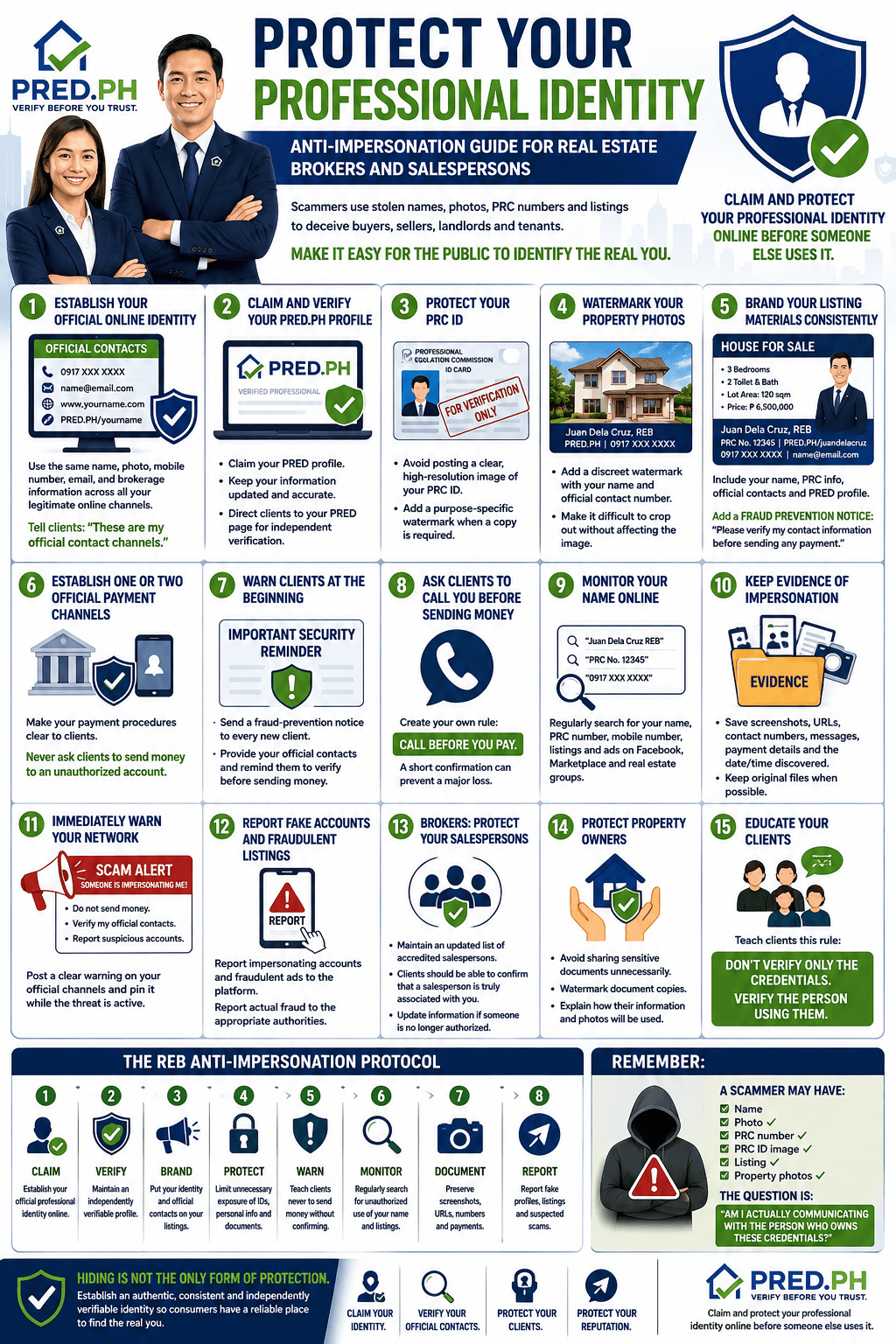
PROTECT YOUR PROFESSIONAL IDENTITY
Anti-Impersonation Guide for Real Estate Brokers and Salespersons
Identity theft is becoming a serious risk in online real estate.
Scammers can copy the name, photograph, PRC credentials, property photos, listings and advertisements of legitimate real estate professionals and use them to deceive buyers, sellers, landlords and tenants.
The frightening part is that the credentials being shown may actually be genuine — but the person using them is not.
The objective, therefore, is not simply to hide your professional identity.
MAKE IT EASY FOR THE PUBLIC TO IDENTIFY THE REAL YOU.
1. ESTABLISH YOUR OFFICIAL ONLINE IDENTITY
Create a consistent professional identity across your legitimate online channels.
Use the same:
Professional name
Professional photograph
Official mobile number
Official email
Brokerage/company information, when applicable
Professional website or page
PRED.PH profile
Tell clients clearly:
"These are my official contact channels."
The easier it is to find the real you, the easier it becomes to identify an impersonator.
2. CLAIM AND VERIFY YOUR PRED.PH PROFILE
Your PRED profile can serve as an independent reference point where the public can check your professional identity.
Keep your profile information accurate and updated.
Whenever possible, direct prospective clients to your PRED page and tell them:
"Please verify my identity and contact information before transacting with me."
Claim and protect your professional identity online before someone else uses it.
3. PROTECT YOUR PRC ID
Your PRC license establishes your professional credentials, but a photograph or copy of your PRC ID can also be misused.
Avoid unnecessarily posting a clear, high-resolution image of your entire PRC ID on social media.
When a copy is legitimately required, consider adding a purpose-specific watermark where appropriate, such as:
FOR CLIENT VERIFICATION ONLY
Submitted to [Name/Organization]
Date: __________
Do not publicly post more personal information than necessary.
4. WATERMARK YOUR PROPERTY PHOTOS
Property photographs are among the easiest materials for scammers to steal.
Consider adding a discreet watermark containing:
Your name | PRED.PH | Official contact number
Example:
Juan Dela Cruz, REB | PRED.PH | 0917 XXX XXXX
Do not make the watermark so large that it destroys the usefulness of the photograph, but make it difficult to crop out without affecting the image.
5. BRAND YOUR LISTING MATERIALS CONSISTENTLY
Create a recognizable format for your online advertisements.
Include:
Your professional name
Your designation
PRC information where appropriate
Official contact number
PRED.PH profile or professional page
Brokerage/company, if applicable
End advertisements with a simple warning:
FRAUD PREVENTION NOTICE
Please verify my contact information before sending any payment. I will never ask you to send money to an unauthorized account.
6. ESTABLISH ONE OR TWO OFFICIAL PAYMENT CHANNELS
Scammers ultimately need somewhere to receive the victim's money.
Make your payment procedures clear to clients.
Tell them:
"Do not send any payment based solely on a Messenger, Viber, WhatsApp, text or email instruction. Confirm payment instructions with me first."
Where appropriate, provide written instructions identifying authorized recipients and payment procedures.
If your payment instructions suddenly "change," clients should know to verify with you independently.
7. WARN CLIENTS AT THE BEGINNING OF THE TRANSACTION
Do not wait until a scam happens.
When a buyer, seller, landlord or tenant first contacts you, send a short fraud-prevention notice.
IMPORTANT SECURITY REMINDER
Scammers sometimes copy the identities and credentials of legitimate real estate professionals.
Before sending money or documents, please confirm that you are communicating with me through my official contact information.
Official mobile: __________
Official email: __________
PRED profile: __________
If someone contacts you using my name but different contact information, please contact me immediately.
8. ASK CLIENTS TO CALL YOU BEFORE SENDING MONEY
This can be one of the simplest safeguards.
Create your own rule:
"CALL BEFORE YOU PAY."
Before a reservation fee, earnest money, rental deposit or other significant payment is sent, ask the client to call your independently verified official number.
A short confirmation can prevent a major loss.
9. MONITOR YOUR NAME ONLINE
Periodically search for:
Your full name
Your name + "real estate"
Your name + "broker"
Your PRC number
Your mobile number
Distinctive wording from your advertisements
Your important property listings
Also watch Facebook Marketplace and real estate groups where your listings commonly appear.
If you discover an unauthorized account or advertisement, preserve evidence before attempting to have it removed.
10. KEEP EVIDENCE OF IMPERSONATION
If you discover someone using your identity, do not rely only on reporting the account immediately.
First document what you found.
Save:
Screenshots
Profile name
Profile URL
Advertisement URL
Telephone numbers
Email addresses
Bank/e-wallet information shown to victims
Property being advertised
Messages received by victims
Date and time discovered
Keep the original files whenever possible.
This information may be important when reporting the incident to the platform or appropriate authorities.
11. IMMEDIATELY WARN YOUR NETWORK
If you discover active impersonation, publish a clear warning through your legitimate channels.
SCAM ALERT — SOMEONE IS IMPERSONATING ME
An unauthorized person/account is using my name, photograph and/or professional credentials in connection with real estate transactions.
Please DO NOT send money or documents to anyone claiming to be me without independently confirming their identity.
My official contact information is:
Mobile: __________
Email: __________
Official PRED profile: __________
If you encounter another account using my identity, please send me the details.
Pin the warning to your social media page while the threat remains active.
12. REPORT FAKE ACCOUNTS AND FRAUDULENT LISTINGS
Report impersonating accounts and fraudulent advertisements to the platform where they appear.
If money has been taken or an actual fraud has occurred, preserve the evidence and consider reporting the incident to the appropriate authorities.
Do not engage in prolonged arguments with the scammer. Prioritize protecting potential victims and preserving evidence.
13. BROKERS SHOULD PROTECT THEIR SALESPERSONS TOO
A broker's identity-protection system should include accredited salespersons.
Maintain an updated list of persons legitimately working under you where applicable.
Clients should be able to confirm:
"Is this salesperson really associated with this broker?"
Salespersons should likewise identify their supervising broker clearly and use consistent official contact information.
If a salesperson leaves or is no longer authorized to represent the broker, update public information promptly.
14. PROTECT PROPERTY OWNERS WHO ENTRUST LISTINGS TO YOU
Your responsibility extends beyond your own identity.
Scammers can steal:
Property photographs
Owner information
Titles and documents
Floor plans
Listing descriptions
Location information
Avoid distributing sensitive documents unnecessarily.
Consider watermarking document copies according to their intended purpose, and explain to property owners how their information and photographs will be used.
15. EDUCATE YOUR CLIENTS
Fraud prevention should become part of professional real estate practice.
Teach every client this rule:
DON'T VERIFY ONLY THE CREDENTIALS. VERIFY THE PERSON USING THEM.
A scammer may possess a copy of a genuine broker's:
Name ✓
Photo ✓
PRC number ✓
PRC ID image ✓
Listing ✓
Property photographs ✓
The question is:
"Am I actually communicating with the person who owns these credentials?"
THE REB ANTI-IMPERSONATION PROTOCOL
Every real estate professional can follow this simple routine:
1. CLAIM
Establish your official professional identity online.
2. VERIFY
Maintain an independently verifiable professional profile.
3. BRAND
Put your identity and official contact information on your listings.
4. PROTECT
Limit unnecessary exposure of IDs, personal information and sensitive documents.
5. WARN
Teach clients never to send money without confirming who they are dealing with.
6. MONITOR
Regularly search for unauthorized use of your name, credentials and listings.
7. DOCUMENT
Preserve screenshots, URLs, contact numbers and payment information when impersonation occurs.
8. REPORT
Report fake profiles, fraudulent listings and suspected scams promptly.
HIDING IS NOT THE ONLY FORM OF PROTECTION
Your professional name and credentials may already appear in legitimate public records, advertisements, social media posts and property listings.
The stronger strategy is to establish an authentic, consistent and independently verifiable professional identity so that consumers have somewhere reliable to find the real you.
CLAIM YOUR IDENTITY.
VERIFY YOUR OFFICIAL CONTACTS.
Philippine Real Estate Directory — in your pocket.
Download the app now
Browse property listings, verify licensed professionals, save favourites, and send inquiries — all in one trusted platform.


Available on the App Store for iPhone and iPad, and on Google Play for Android.
Licensed professionals
Browse listings and profiles from credential-reviewed practitioners.
Search on the go
Find properties, professionals, news, and wanted inquiries anytime.
Save favourites
Keep a shortlist and revisit listings anytime.