Sold, but Still Waiting for the Commission: Financial Survival for Real Estate Brokers and Agents
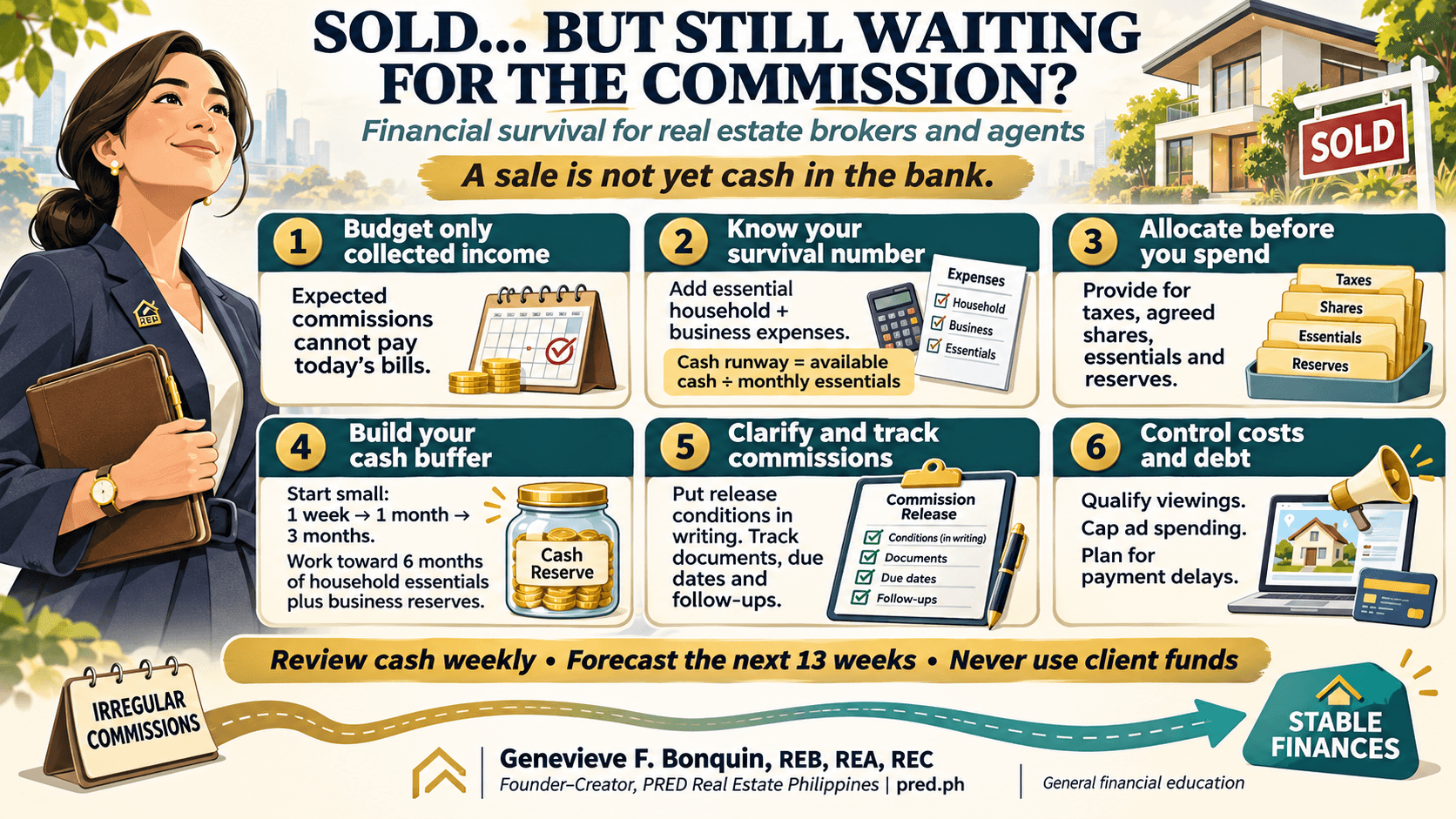
Sold, but Still Waiting for the Commission: Financial Survival for Real Estate Brokers and Agents
By Genevieve F. Bonquin, REB, REA, REC
Founder–Creator, PRED Real Estate Philippines
A buyer reserves a property. Another signs the contract. A seller says the commission will be released soon. Your sales report looks encouraging—but your bank balance tells a different story.
Meanwhile, fuel, tolls, parking, mobile data, advertising, groceries, and household bills must be paid.
For individual real estate brokers and agents, financial management begins with recognizing this reality: a sale and a cash collection are two different events. You need a system that keeps your household and practice functioning between them.
1. Build your budget around money collected
Do not spend a commission simply because a buyer has reserved, signed, or started paying.
Depending on the written arrangement, release may depend on a required payment threshold, completed buyer documents, loan proceeds, full payment, or other conditions. Even after those conditions are met, processing may take time.
Separate your pipeline into four categories:
Category
What it means
How to use it
Potential commission
Transaction is still being negotiated
Prospecting forecast only
Conditional commission
Transaction exists, but release conditions remain unmet
Track requirements; do not fund bills with it
Due and unpaid
Contractual conditions and payment deadline have been met
Follow up and escalate collection
Collected income
Funds have cleared
Allocate to obligations, reserves, and household needs
A payment awaiting a future contractual milestone is different from an overdue payment. Knowing which situation applies helps you take the right action.
2. Know your minimum monthly survival number
Prepare two budgets: one for your household and another for your real estate practice.
Your household minimum includes food, housing, utilities, necessary transport, medicines, dependents’ needs, and minimum debt payments. Your business minimum includes essential communication, approved property visits, necessary tools, and provision for recurring professional obligations.
For example:
Essential monthly requirement
Illustrative amount
Household needs
₱25,000
Essential business expenses
₱8,000
Combined monthly requirement
₱33,000
These figures are examples, not recommended spending levels.
If you have ₱66,000 in unrestricted cash after setting aside taxes and other people’s money, you have approximately two months of coverage at this spending level.
Cash runway = available unrestricted cash ÷ essential monthly spending.
Do not include client funds, expected commissions, or unused credit limits.
Your survival number tells you when you must reduce costs, seek additional income, or change the mix of transactions you pursue.
3. Pay yourself a controlled household allowance
A large commission can create the impression that you can finally afford everything you postponed. But that payment may need to support several months without another collection.
Keep business collections separate from everyday household spending. Transfer a planned household allowance weekly or monthly, based on available reserves and conservative collection history.
If you collect ₱180,000 but your combined household and business requirements are ₱33,000 monthly, the payment represents about 5.5 months of coverage before taxes, commission sharing, transaction costs, debts, and reserve contributions.
Its practical value is how long it sustains you.
Discuss this with your family. A good collection month should help stabilize the months that follow.
4. Allocate every commission before spending it
Start by reconciling the gross commission, withholding, actual bank receipt, and any amounts owed to co-brokers or salespersons. Avoid counting withholding twice or treating another practitioner’s share as your income.
Then allocate your available share in this order:
Provide for taxes and required obligations.
Cover immediate essential household and business expenses.
Replenish the reserve used while waiting for payment.
Pay down costly debt and cover upcoming annual expenses.
Fund measured business growth and personal wants.
There is no universal allocation percentage. A broker supporting dependents with expensive debt needs a different plan from someone with a second household income and substantial savings.
Ask your accountant to help estimate your tax provision using your registration, applicable tax treatment, expenses, and withholding credits. Keep the supporting records and withholding certificates.
5. Build reserves in stages
Saving several months of expenses may feel impossible when you are already waiting for commissions. Start with a smaller milestone:
First, one week of essential expenses.
Next, one month.
Then, three months.
Eventually, a larger buffer appropriate to your collection cycle.
BSP financial education materials discuss emergency reserves of several months and emphasize adjusting the amount to individual circumstances. For a household heavily dependent on commissions, I recommend working toward six months of essential household expenses, plus a separately identified business operating reserve. Longer delays or greater family responsibilities may justify more.
Distinguish predictable income gaps from emergencies. Waiting through a normal commission cycle requires working capital; illness or an urgent repair requires emergency savings. If you initially use one account, track the purposes separately so you do not count the same money twice.
Keep money needed soon accessible and relatively stable. It should not depend on selling a volatile investment at the right moment.
6. Clarify commission terms before spending heavily
Before committing substantial time and money, obtain written clarity on:
Who owes the commission and how it is calculated.
The broker’s share and any salesperson or co-broker allocation.
The exact event that makes payment due.
Required buyer and broker documents.
The processing period after complete submission.
Cancellation, refund, or clawback provisions.
Agreed advertising and reimbursable expenses.
Ask a specific question: “If the buyer completes the payment requirement but submits documents two months later, when does the commission become payable?”
If payment comes only after full payment over several years, assess whether you can afford to carry that work. You may propose milestone payments or a different expense arrangement, but these require agreement; they are not automatic entitlements.
For accredited salespersons, coordinate payment arrangements with the supervising broker. Under RA 9646, salespersons receive their transaction compensation through their supervising licensed broker, rather than demanding it directly from other parties.
7. Manage collections as carefully as prospecting
Maintain a commission tracker with the transaction, payer, amount, release conditions, missing documents, submission acknowledgment, contractual due date, latest follow-up, and next action.
For installment transactions, record the payment milestone that triggers release. Do not assume every buyer installment produces a commission installment.
Use a document checklist early. Explain requirements to buyers, identify missing items, and coordinate submissions through appropriate secure channels. This can reduce preventable delays, although it cannot guarantee payment.
When following up, ask for specifics:
“Please confirm whether the commission requirements are complete. If anything remains outstanding, kindly identify the item, the responsible person, and the expected completion date. If complete, please confirm the scheduled release date.”
Age overdue amounts from the contractual due date. Escalate persistent delays through the appropriate broker, accounting contact, or management channel, preserving written records. For a disputed or significant unpaid claim, obtain legal advice.
8. Put limits on property visits and advertising
Every viewing costs time and effort, even when no cash receipt is issued.
Before traveling, confirm the buyer’s budget range, financing readiness, preferred location, purchase timing, and decision-makers. Share accurate information and suitable photos or a virtual tour first. Confirm access and attendance before departure, and group nearby appointments when practical.
Set a spending limit for each listing or campaign. Reassess any arrangement involving repeated long-distance visits, unclear authority, or an owner unwilling to provide documents.
For advertising, measure qualified inquiries, attended viewings, and collected income—not just likes or messages. Test with a small amount you can afford to lose. Expand spending only when evidence supports it.
Agree in writing who pays for owner-approved photography, special marketing, and other substantial costs. Do not assume reimbursement.
9. Build a mix of income timelines
A practice that relies entirely on transactions with long release conditions is vulnerable, even when the pipeline is large.
Consider a mix of suitable resale, leasing, and project transactions with different collection timelines. Leasing may sometimes collect sooner, but vacancies, negotiations, documentation, and payment terms still create uncertainty.
Other paid work may help, including property management, administrative services, teaching, or work outside real estate—provided you have the necessary competence, authority, and agreements. Appraisal and consultancy require the appropriate professional qualifications and licenses.
Choose work that serves clients properly and supports your finances. Do not steer buyers toward an unsuitable property simply because its commission releases faster.
10. Borrow only with a credible repayment plan
Borrowing against an expected commission becomes dangerous when the release moves again.
Before borrowing, calculate the total repayment, fees, interest, and due dates. Ask: “How will I repay this if the commission arrives three months late—or never arrives?”
If you don't have a credible answer, cut spending and find another income source before taking on debt.
Avoid repeatedly taking cash advances or new loans to pay earlier borrowing. If existing payments are becoming unmanageable, contact creditors early to discuss available arrangements.
Never use reservation payments, buyer deposits, or other entrusted client funds to support your household or practice.
When cash is already running short
Prepare a weekly cash forecast for the next 13 weeks. Enter your opening available balance, essential payments, and realistic collections. Keep uncertain commissions outside the baseline and show them separately as possible outcomes.
Then take immediate action:
Pause discretionary spending and advertising that is not producing useful results.
Follow up on commissions already due and resolve outstanding requirements.
Preserve funds for food, housing, medicines, essential communication, and productive work.
Discuss payment difficulties with creditors before missing deadlines.
Seek suitable supplementary income while maintaining client commitments.
Do not promise creditors a commission release date that the payer has not confirmed—and recognize that even confirmed dates can slip.
Make financial review a weekly habit
Set aside 30 minutes each week to review cash, upcoming bills, pending requirements, overdue collections, and marketing costs. A spreadsheet or CRM can help, as long as the entries stay current.
Financial difficulty does not automatically mean a broker lacks selling ability. A practitioner can work hard and close transactions while still facing a serious cash shortage.
The goal is to build a practice that can withstand the waiting period: reasonable expenses, clear agreements, disciplined collection follow-up, accessible reserves, and a household budget that respects irregular income.
Your next commission should strengthen your financial position, not just rescue you until the next release.
This article offers general financial education. Review specific tax treatment, contractual rights, and debt decisions with the appropriate professional.
Sources
Bangko Sentral ng Pilipinas: Personal Financial Management Speaker Guide.
Bangko Sentral ng Pilipinas: Financial Planning 101.
Supreme Court E-Library: Republic Act No. 9646, Section 31.
Philippine Real Estate Directory — in your pocket.
Meeting a broker today? Check them on the spot.
The free PRED app puts the directory in your pocket. Verify a broker in the middle of a tripping, save listings you like, and send inquiries to licensed professionals anywhere in the Philippines.


Available on the App Store for iPhone and iPad, and on Google Play for Android.
Licensed professionals
Browse listings and profiles from credential-reviewed practitioners.
Search on the go
Find properties, professionals, news, and wanted inquiries anytime.
Save favourites
Keep a shortlist and revisit listings anytime.