Sold Twice, Owned by None: The Double Sale Scam
Part 2 of 5 — Buyer Beware: Illegal Real Estate Practices in the Philippines
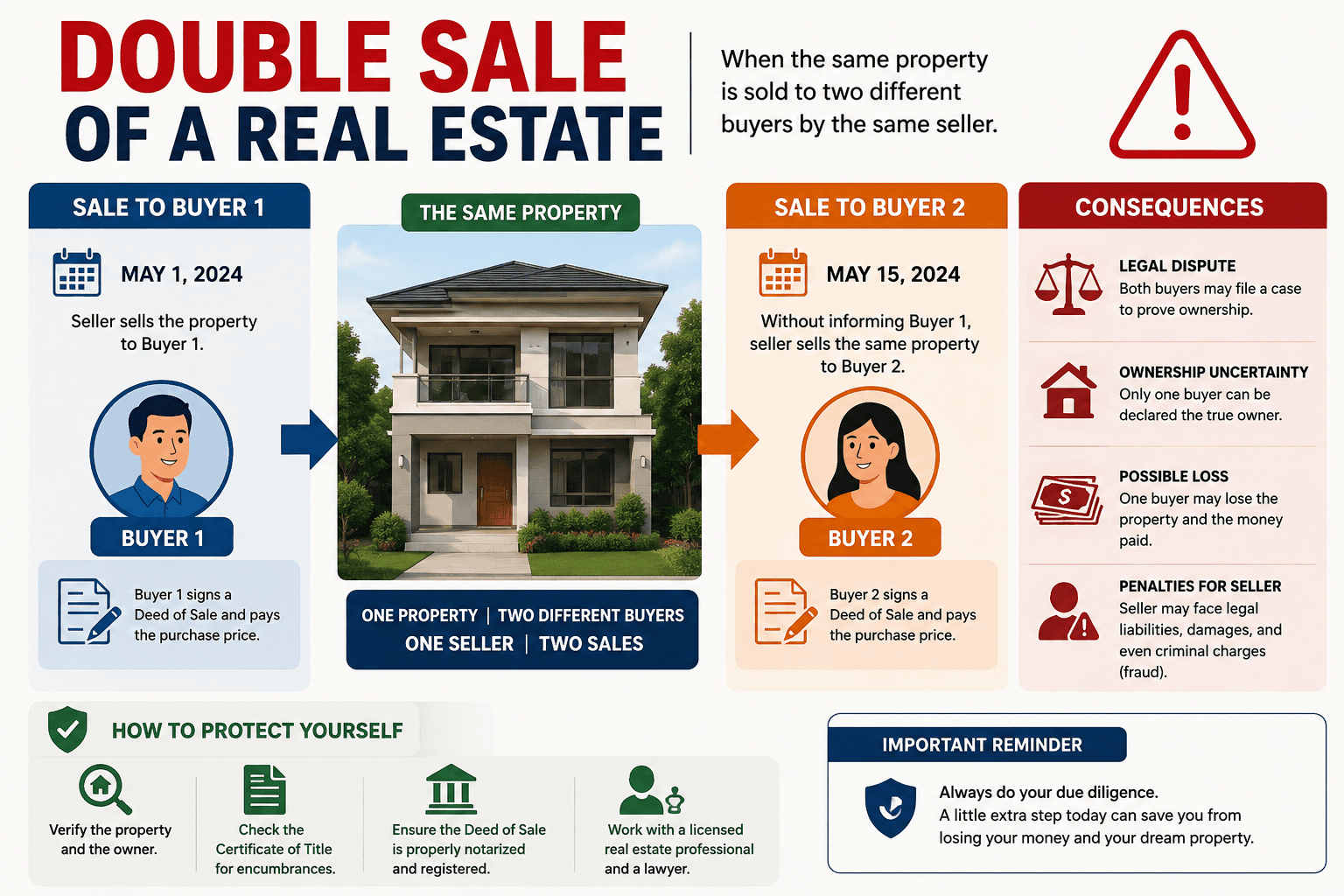
You signed a deed of sale. You have a notarized contract. You even moved into the property. Then one day, a stranger knocks on your door with their own deed of sale — for the exact same house. You both paid the same seller. Only one of you will end up owning it. The other loses everything.
This is the double-sale scam, one of the most legally complex — and financially devastating — real estate crimes in the Philippines. What makes it especially cruel is that both buyers are often completely innocent. The villain is the seller who collects from two people and disappears.
What Is a Double Sale?
A double sale happens when the same seller sells the same property to two or more different buyers. It can involve land, a house and lot, or a condominium unit. The seller may use the original genuine title both times, making each transaction appear perfectly legitimate — until both buyers try to assert their ownership at the same time.
This is not a rare edge case. It is a recurring scheme across Metro Manila, Cavite, Cebu, Davao, and other fast-growing areas where demand for housing is high, and buyers are eager to close deals quickly.
How the Scam Works
Unlike forged title fraud, the double sale scam does not always require fake documents. A dishonest seller can execute it using entirely real paperwork — which is precisely what makes it so dangerous.
Step 1 — The first sale. The seller signs a deed of sale with Buyer A and receives payment, in full or in part. However, instead of immediately helping Buyer A register the sale with the Registry of Deeds, the seller stalls—citing processing delays, unpaid taxes, or other excuses.
Step 2 — The second sale. While Buyer A waits, the seller approaches Buyer B, presents the same clean title, and executes another deed of sale. Buyer B, seeing no annotations on the title indicating a prior sale, pays in good faith.
Step 3 — The race to register. Whoever registers the sale first at the Registry of Deeds gains a massive legal advantage. If Buyer B registers first — even though Buyer A signed the contract earlier — Buyer B may end up owning the property under Philippine law.
Step 4 — The seller vanishes. Once the second payment is collected, the seller disappears with both buyers' money, leaving them to fight each other in court.
What the Law Says: Article 1544 and the "First to Register" Rule
The governing law on double sales is Article 1544 of the Civil Code of the Philippines, and its logic may surprise you. The law does not simply give the property to the buyer who signed the contract first. For real property (land, houses, condominiums), it follows a three-step hierarchy:
First to register in good faith wins. The buyer who first registers the sale at the Registry of Deeds — and had no knowledge of any prior sale when they bought — gets the property.
If no one has registered: first possessor in good faith wins. If neither buyer has registered, whoever first took physical possession of the property, in good faith, prevails.
If neither registered nor taken possession: oldest title wins. The buyer with the earliest-dated valid contract, in good faith, gets the property.
The critical phrase throughout is "in good faith." A buyer who knew about the first sale before they bought cannot claim this protection. As the Supreme Court has affirmed, knowledge of a prior sale defeats any advantage the second buyer might otherwise have under Article 1544.
This means two things for ordinary homebuyers: first, you must register your purchase as quickly as possible; and second, you must conduct due diligence to ensure there is no prior sale before you buy.
A Real Case: The Tayamen v. Bangit Story
The Supreme Court case of Spouses Tayamen v. People (G.R. No. 246986, April 28, 2021) illustrates exactly how this plays out in real life. The Tayamen spouses sold a 120-square-meter parcel of land in Dasmariñas, Cavite to Ma. Mildred Bangit for ₱800,000. Sometime later, Bangit discovered through the Registry of Deeds that the same spouses had sold the very same property to another couple.
Bangit demanded her money back. When the Tayamens refused, she filed a criminal complaint for Estafa under Article 316(2) of the Revised Penal Code — the specific provision that punishes the sale of property while concealing that it is already encumbered or sold. The case confirms that a seller who knowingly sells the same property twice, and misrepresents it as free from any prior transaction, faces criminal liability — not just civil consequences.
Why Buyers Fall for It
Several factors make homebuyers vulnerable to double sale schemes:
Delayed registration is common. Many buyers — especially those on installment plans or waiting for loan approval — do not register the sale right away. This gap is exactly what dishonest sellers exploit.
OFWs and remote buyers are easy targets. When the buyer is abroad or lives far from the property, the seller controls the timeline and can execute a second sale before the first buyer even realizes something is wrong.
Trust in notarized documents. Buyers often believe that a notarized deed of sale is sufficient protection. It is not — notarization proves the document was signed, but it does not prevent the same seller from signing another one.
Urgency and pressure. Sellers who intend to double-sell may push the first buyer to close quickly, then do the same with the second, collecting two payments before either buyer registers.
How to Protect Yourself
1. Register the sale immediately — do not wait. The moment a deed of sale is executed, begin the process of transferring the title to your name at the Registry of Deeds. Every day you delay is a window for fraud. This is the single most effective protection against double sale schemes.
2. Check for existing annotations before you buy. Before signing anything or handing over money, go to the Registry of Deeds and obtain a Certified True Copy of the title. Look carefully at the annotations section for any prior deeds of sale, mortgages, liens, or adverse claims. A suspiciously blank annotation section on a property with a long history is worth questioning.
3. File an adverse claim if registration will take time. If there will be a delay before full title transfer — for example, because you are on an installment plan — consider registering an adverse claim at the Registry of Deeds. This annotates the title with notice of your interest in the property, putting any future buyer on notice that a prior transaction exists.
4. Insist on a Deed of Absolute Sale, not just a Contract to Sell. Note that Article 1544 applies to actual contracts of sale, not contracts to sell (where ownership transfers only upon full payment). Understanding the difference matters when it comes to asserting your rights.
5. Do not rely on the seller to handle registration for you. Some sellers offer to "take care of all the paperwork." Decline this arrangement. Always handle the registration process yourself, or hire a lawyer to do it on your behalf, so you control the timeline.
6. Verify the seller's identity and authority. Confirm that the person selling the property is indeed the registered owner, or has a properly notarized Special Power of Attorney from the owner. Cross-check their government-issued ID against the name on the title.
What to Do If You Are a Victim
If you discover you have been the victim of a double sale, you have several options:
File a criminal complaint for Estafa (Article 315 or 316 of the Revised Penal Code) at the Office of the City or Provincial Prosecutor. A seller who deliberately sells the same property twice, concealing the prior transaction, faces imprisonment and fines.
File a civil case for rescission of the fraudulent contract, recovery of the amount paid, and damages — including moral and exemplary damages if bad faith is proven.
Register an adverse claim immediately to protect your interest while the dispute is being resolved.
Consult a real estate lawyer as soon as possible. In double-sale cases, timing is everything, and early legal action can mean the difference between recovering the property and recovering only money.
The Bottom Line
In a double sale, the law does not reward whoever paid first — it rewards whoever registered first in good faith. This is a counterintuitive rule that costs unprepared buyers dearly. The moment you sign a deed of sale, registration is not a mere formality to be completed eventually. It is the single act that converts your contract into legally protected ownership.
Never let a seller control that step for you. Never delay it. And before you buy, always check what the title already says.
In our next article, we look at the Ghost Project — pre-selling scams where developers take your money for properties that are never built, and what the law requires them to deliver.
Philippine Real Estate Directory — in your pocket.
Download the app now
Browse property listings, verify licensed professionals, save favourites, and send inquiries — all in one trusted platform.


Available on the App Store for iPhone and iPad, and on Google Play for Android.
Licensed professionals
Browse listings and profiles from credential-reviewed practitioners.
Search on the go
Find properties, professionals, news, and wanted inquiries anytime.
Save favourites
Keep a shortlist and revisit listings anytime.