The Ghost Project: Pre-Selling Scams and Abandoned Developments
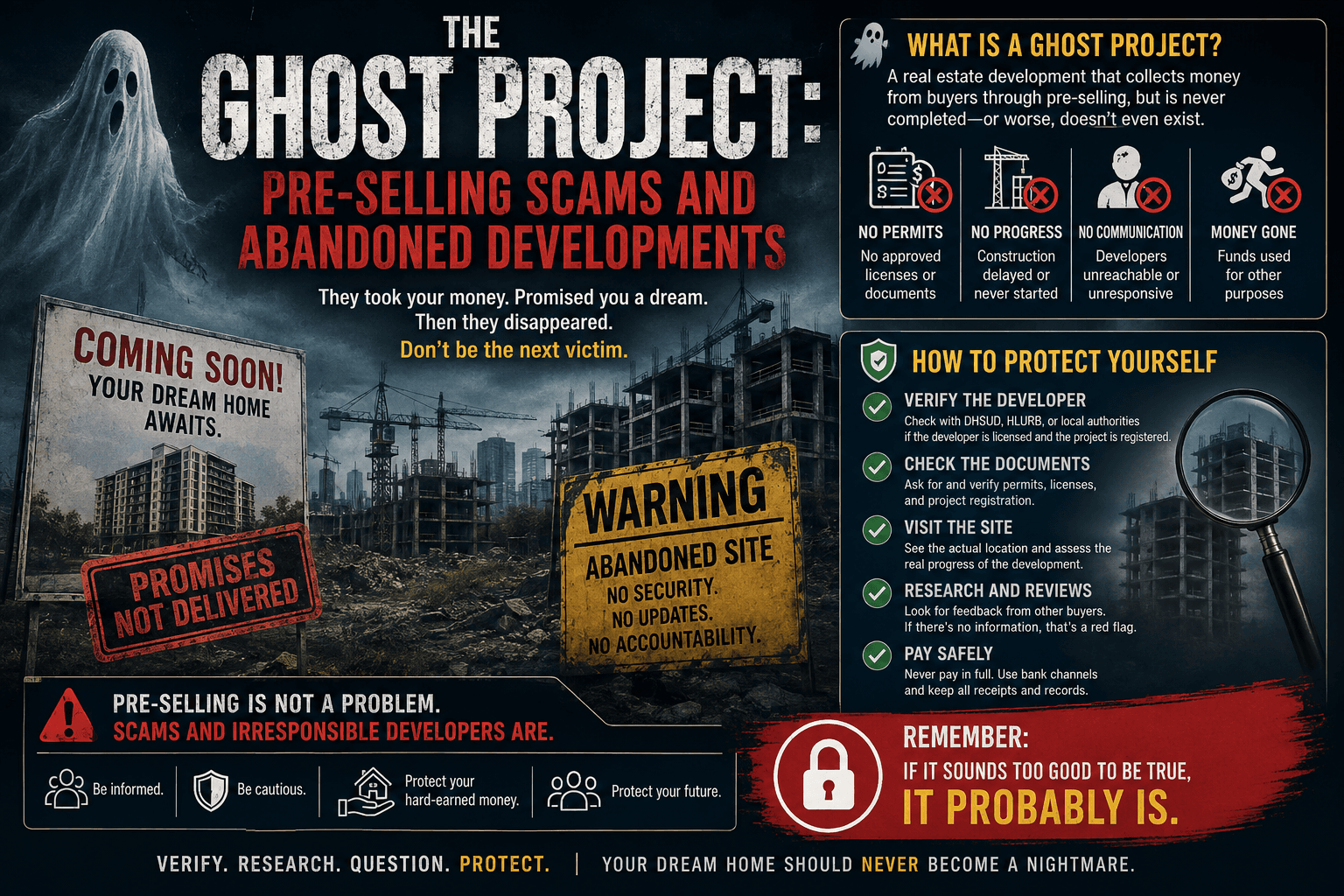
The Ghost Project: Pre-Selling Scams and Abandoned Developments
Part 3 of 5 — Buyer Beware: Illegal Real Estate Practices in the Philippines
The brochure is stunning. Glossy renders show a gleaming tower with a rooftop pool, a children's playground, and a lobby that looks like a five-star hotel. The sales agent is charming. The price — offered at a special pre-selling rate — feels like a once-in-a-lifetime deal. You sign a contract to sell and start paying monthly installments.
Two years later, construction has stalled. The developer's office phone is disconnected. The project website is down. And you are still paying — or have already paid in full — for a property that may never exist.
This is the ghost project scam, the most common form of real estate fraud targeting Filipino homebuyers today. It works because of a perfectly legal practice — pre-selling — that unscrupulous developers and fake agents have learned to exploit.
What Is Pre-Selling?
Pre-selling is the practice of marketing and selling condominium units or subdivision lots before construction is complete — sometimes before the first shovel of earth is turned. It is widely used by legitimate developers because it lets them raise capital from buyers to fund construction, and it lets buyers lock in lower prices before the project is finished.
Pre-selling is legal in the Philippines — but only under specific conditions. <br>Under Presidential Decree No. 957 (PD 957), also known as the Subdivision and Condominium Buyers' Protective Decree, a developer cannot lawfully sell, advertise, or even offer to sell any lot or unit without first securing two things from the Department of Human Settlements and Urban Development (DHSUD):
A Certificate of Registration (CR) — confirming the project has been reviewed and registered with the government
A License to Sell (LTS) — authorizing the developer to accept payments from buyers
Selling before either of these is issued is strictly illegal. Yet it happens constantly — and that gap is where the scam begins.
How the Scam Works
Ghost project schemes come in two main forms, sometimes overlapping:
Form 1 — The Unlicensed Developer or Agent
A person or company poses as a legitimate developer or real estate agent, advertising a pre-selling project — often through Facebook, Instagram, or aggressive in-person sales events — without holding a valid License to Sell from DHSUD.
They collect reservation fees, down payments, and monthly installments for months or even years. At some point, they disappear. The project was never approved, never financed, and in the worst cases, never even planned in any serious way.
These fraudsters are sometimes called "colorum agents" — unlicensed operators who present themselves as affiliated with legitimate companies to gain credibility. They may build convincing websites, produce professional-looking brochures, and even set up temporary showrooms to simulate legitimacy.
Form 2 — The Abandoning Developer
This version is more insidious because it begins as a legitimate transaction. A properly licensed developer sells units in a pre-selling project, collects years of payments — then runs out of money, mismanages funds, or deliberately diverts buyer payments and abandons the project mid-construction.
Buyers arrive at the project site to find a half-built shell, frozen construction equipment, and unpaid workers. The developer claims "temporary delays" that stretch into years. Eventually, it becomes clear the project will never be completed.
Why Pre-Selling Is the Most Targeted Transaction Type
Pre-selling is the transaction type most frequently exploited by scammers in the Philippines for a straightforward reason: buyers are paying for something that does not yet exist. There is no physical unit to inspect, no neighbors to interview, and no title to verify at the Registry of Deeds. All the buyer has is a contract, a render, and a promise.
This makes verification harder and gives fraudsters a longer runway before the deception is discovered — often long enough for them to collect substantial payments and disappear.
OFWs and buyers purchasing remotely are particularly vulnerable. When you are managing a transaction from abroad, you rely heavily on the sales agent's representations, and you cannot easily visit the construction site to check on progress.
Red Flags to Watch Out For
The following warning signs should make any buyer pause and investigate before paying a single peso:
No License to Sell number in the contract or advertising materials. Legitimate developers display their LTS number prominently. If it is absent, ask for it — and verify it.
Pressure to pay a "reservation fee" immediately. A common tactic is to create urgency — "the promo price ends today," or "only two units left at this rate." Legitimate developers do not require you to pay before you can verify their credentials.
Prices that are dramatically below market rate. If a condo in a prime area is being offered at a price that seems impossible, it likely is.
The developer has no track record of completed projects. A first-time developer with no finished projects, no physical office, and no verifiable history is a major risk.
Vague or missing construction timelines. Legitimate contracts include specific delivery dates backed by developer obligations under PD 957.
You cannot find the project in DHSUD's records. DHSUD maintains a registry of all registered projects and licensed developers. If the project does not appear, the developer is operating illegally.
What the Law Requires Developers to Do
Under PD 957, legitimate developers are bound by strict obligations to buyers:
They must complete the project — including roads, drainage, utilities, and promised amenities — within the timeframe stated in their DHSUD license.
They cannot mortgage the project land or units without prior written approval from DHSUD. If a developer mortgages the property and defaults on a bank loan, the bank cannot foreclose on units that have already been fully paid for by buyers.
If the developer fails to complete the project, abandons it, or has its License to Sell revoked, buyers have the right to cancel the contract and demand a full refund of all payments made, with interest.
PD 957 is clear: when the fault lies with the developer, the buyer is entitled to 100% recovery of payments. The burden is on the developer to deliver — not on the buyer to absorb the loss.
How to Protect Yourself Before You Buy
1. Verify the License to Sell with DHSUD. Before signing anything or paying any amount, go to the DHSUD office or visit their online verification portal to confirm the project has both a Certificate of Registration and a valid License to Sell. Ask the developer to show you a copy and cross-check it yourself.
2. Research the developer's track record. Look up the developer's completed projects. Visit one if you can. Talk to residents. A developer with a solid history of on-time delivery is a far safer bet than one with no portfolio.
3. Inspect the actual project site. For ongoing pre-selling projects, visit the construction site and observe the pace of work. Is equipment present? Are workers active? Does the site match what you were shown in the brochure?
4. Read the Contract to Sell carefully. The contract must include a specific delivery date. If it contains only vague language, such as "when construction is complete" or "subject to change," that is a warning sign. Your contract should also spell out the developer's obligations and your rights in the event of a delay or non-delivery.
5. Demand official receipts for every payment. Every payment you make — reservation fee, down payment, monthly installment — must be accompanied by an official receipt bearing the developer's registered business name. Unofficial receipts or handwritten acknowledgments offer you no legal protection.
6. Verify the agent's PRC license. Under the Real Estate Service Act (RA 9646), anyone who sells real estate for compensation must hold a valid Professional Regulation Commission (PRC) license. Ask for the agent's PRC ID and verify it at prc.gov.ph.
What to Do If You Are Already a Victim
If your developer has abandoned the project or failed to deliver your unit:
File a complaint with DHSUD. This is your primary remedy under PD 957. DHSUD can order the developer to refund your payments, impose administrative fines, and revoke the developer's License to Sell. The process involves a mandatory mediation stage (usually within 30 days of filing) before escalating to formal adjudication.
Demand a full refund in writing. Send a formal written demand to the developer citing PD 957 and the specific breach. This establishes the date your demand was made, which matters for computing interest.
File a criminal complaint for Estafa if the developer collected payments while knowing the project could not be completed or was never properly licensed. This can be filed with the Office of the City or Provincial Prosecutor or the NBI.
Organize with other buyers. Ghost project victims who act together are far more effective. A group complaint to DHSUD carries more weight than individual cases, and collective legal action can be more economical.
Under PD 957, if the developer is found at fault, you are entitled to a full refund of all payments made, including interest. This is not a discretionary remedy — it is your legal right.
The Bottom Line
Pre-selling is not inherently a scam. Many of the Philippines' best housing developments were sold before a single wall was built. But the pre-selling format — payment for something that does not yet exist — creates a window of vulnerability that dishonest developers and fake agents are quick to exploit.
The safeguards are available: PD 957 is a powerful law, and DHSUD exists precisely to enforce it. But the law can only protect you after a problem arises. Before you pay, the most powerful protection is your own due diligence — verify the License to Sell, check the developer's track record, and never let urgency or a promotional price override that step.
In our next article, we look at the "Yuta Data-Data" scheme — where buyers are sold raw, unregistered land that can never be titled, and why a tax declaration is not the same as a land title.
This article is for informational purposes only and does not constitute legal advice. Consult a licensed attorney for guidance on specific situations.
Philippine Real Estate Directory — in your pocket.
Download the app now
Browse property listings, verify licensed professionals, save favourites, and send inquiries — all in one trusted platform.


Available on the App Store for iPhone and iPad, and on Google Play for Android.
Licensed professionals
Browse listings and profiles from credential-reviewed practitioners.
Search on the go
Find properties, professionals, news, and wanted inquiries anytime.
Save favourites
Keep a shortlist and revisit listings anytime.